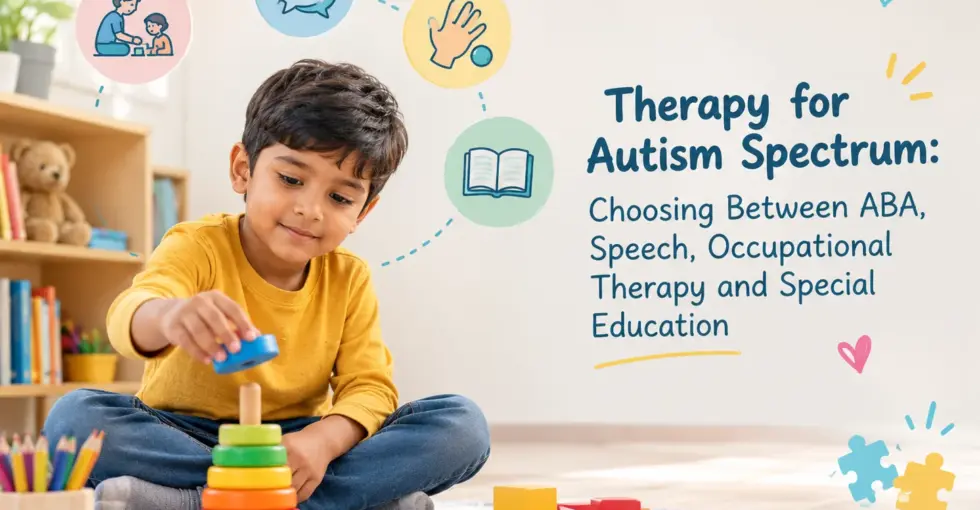

After an autism diagnosis, many parents are given a list of therapy names:
ABA. Speech therapy. Occupational therapy. Sensory support. Special education.
The difficult part is rarely understanding that therapies exist.
The difficult part is knowing:
Which one does my child actually need first?
Some families are advised to start several therapies at once. Others are told that one particular approach should come before everything else.
In reality, there is no universal therapy sequence that suits every autistic child.
One child may be communicating effectively but struggling with dressing, sensory regulation and classroom routines. Another may need a reliable way to communicate basic needs. Another may be academically capable but find social interaction and flexibility extremely difficult.
The most useful therapy for autism spectrum is therefore not selected from the diagnosis alone.
It should be selected by asking:
Which difficulty is having the biggest impact on this child’s everyday life right now?
That question provides a much better starting point for families.
Which Therapy Does an Autistic Child Need?
The answer depends on the child’s individual needs.
| Main Difficulty | Support That May Be Considered |
| Communicating wants, needs or ideas | Speech and language therapy |
| Daily living, sensory or motor difficulties | Occupational therapy |
| Behaviour interfering with safety, learning or routines | Behavioural/ABA-based support |
| Learning and academic participation | Special education |
| Several areas affected together | Multidisciplinary assessment and coordinated plan |
This is only a starting framework.
A qualified professional should assess the child before recommending a therapy plan.
The goal is not to enrol a child in every available service.
The goal is to identify the most important functional priorities.
What Is Therapy for Autism Spectrum?

Therapy for autism spectrum refers to professional support aimed at helping an autistic child participate more effectively in everyday life.
Depending on individual needs, goals may include:
- communicating wants and needs
- understanding language
- managing everyday routines
- participating in school
- developing self-care skills
- reducing barriers to learning
- improving motor or sensory participation
- increasing independence
- supporting social communication
Autism support should not be about making a child appear less autistic.
A stronger goal is:
Help the child communicate, participate and function with greater comfort and independence.
Parents who want an overview of multidisciplinary services can learn more about Autism Treatment and how individualised autism-support planning can combine different therapies when appropriate.
Do All Autistic Children Need the Same Therapy?
No.
Two children with the same diagnosis can have very different needs.
For example:
Child A
Speaks in sentences but struggles with:
- understanding social situations
- changing routines
- classroom participation
- emotional regulation
Child B
Uses very limited spoken language and becomes frustrated when unable to communicate.
Child C
Communicates well but struggles with:
- dressing
- handwriting
- food textures
- loud environments
- everyday self-care
The same therapy plan would not make sense for all three.
This is why the first step after diagnosis should ideally involve identifying the child’s functional profile, not simply selecting therapies based on the diagnosis name.
ABA vs Speech Therapy vs Occupational Therapy: What’s the Difference?

These services can overlap in some areas, but their main focus differs.
ABA or Behavioural Therapy
Behavioural approaches examine how skills are learned and what factors influence behaviour.
Depending on the child’s needs, therapy may address:
- following routines
- requesting help
- transitions
- waiting
- learning readiness
- functional communication
- independence
- safety-related behaviours
- behaviours that significantly interfere with participation
A useful behavioural goal should describe something meaningful.
Instead of:
“Improve behaviour.”
a more practical goal might be:
“The child will request a break instead of leaving the classroom when overwhelmed.”
The focus should be on functional skills rather than making a child behave in a way that simply appears more typical.
What Does Speech Therapy Do for Autism?
Speech therapy is not only about pronunciation.
For an autistic child, communication support may address:
- understanding language
- expressing wants and needs
- functional communication
- vocabulary
- combining words
- conversation
- social communication
- answering questions
- speech clarity
- turn-taking
- alternative communication systems
Some autistic children speak fluently but struggle to communicate effectively in social situations.
Others may use a few spoken words, gestures, signs, picture systems, communication boards or AAC devices.
The objective should be effective communication, not spoken words at any cost.
Families looking for local communication support can review Speech Therapy in Jalandhar for assessment-led speech and language services.
What Are the Benefits of Speech Therapy for Autism?
The benefits depend on the child’s starting point.
Progress might mean:
For a Child With Limited Communication
Requesting water, food, help or a favourite activity more independently.
For a Child Who Uses Words
Building longer or more useful sentences.
For a Child With Strong Vocabulary
Improving conversation, storytelling or understanding of social communication.
For a Child Using AAC
Using the communication system more independently across home and school.
Parents should therefore avoid measuring progress only by asking:
“How many new words did my child learn?”
A better question is:
“Is my child becoming better able to communicate what they actually need or want to communicate?”
AAC Is Communication Too
AAC stands for augmentative and alternative communication.
It can include:
- pictures
- communication boards
- signs
- apps
- tablets
- speech-generating devices
For some autistic children, AAC provides a reliable communication method when spoken language is difficult.
Using AAC does not mean that communication therapy has failed.
The ability to independently communicate help, stop, more, finished, pain, yes, no, or I want that can significantly change everyday life.
What Does Occupational Therapy Do for Autism?
Occupational therapy focuses on participation in everyday activities.
For children, “occupation” includes activities such as:
- dressing
- eating
- writing
- playing
- participating in school
- using utensils
- grooming
- toileting routines
- moving through everyday environments
OT may also consider sensory processing when sensory responses interfere with daily participation.
A child might avoid particular clothing textures, cover their ears in noisy spaces, struggle with tooth brushing, find sitting at a desk difficult or need substantial help with dressing.
These behaviours should not automatically be interpreted as disobedience.
Sometimes the child is finding the task or environment genuinely difficult.
Parents can learn more about Occupational Therapy and how functional, sensory and motor skills may be assessed.
Occupational Therapy Goals Should Connect to Real Life
An OT goal becomes more meaningful when it affects everyday participation.
Instead of:
“Improve fine-motor skills.”
consider:
“Child will independently manage buttons required for the school uniform.”
Instead of:
“Improve sensory regulation.”
consider:
“Child will use an agreed strategy to participate more comfortably during noisy classroom activities.”
The question should always be:
What will this skill allow the child to do in everyday life?
Where Does Special Education Fit?
Special education is often missing from discussions that focus only on ABA, speech and OT.
But for some autistic children, learning and classroom participation are major priorities.
A special educator may support:
- academic readiness
- reading
- writing
- maths
- attention to structured tasks
- classroom routines
- concept development
- individualised learning goals
- adapting teaching methods to the child’s learning profile
A child may understand language but still need substantial educational support.
Another child may make progress in therapy but struggle to use those skills in the classroom.
Families looking for educational support can explore Special Education Therapy in Jalandhar when learning and school participation are part of the child’s support needs.
What Does Government Guidance Say About Autism Therapies?
Government of India CGHS guidance for Autism Spectrum Disorder recognises occupational therapy, speech therapy, ABA-based behavioural therapy and special education as distinct support services. The guidance explains that these therapies may address sensory, motor, behavioural, social-communication and daily-living difficulties, with the broader aim of improving independence and participation at home, school and in the community.
This supports an important principle:
Autism intervention should be selected according to the child’s functional needs rather than following one standard therapy package.
So Which Therapy Should Come First?
There is no universal first therapy.
Start with the area currently creating the greatest functional barrier.
If Your Child Cannot Reliably Communicate Basic Needs
A speech and language assessment may be an important starting point.
If Everyday Tasks Are Extremely Difficult
Consider whether occupational therapy assessment is relevant.
Examples include dressing, feeding, sensory distress, school participation, fine-motor tasks or self-care.
If Behaviour Regularly Prevents Participation
A behavioural assessment may help identify what happens before the behaviour, what the child may be communicating and which replacement skills could help.
If Learning Is the Main Concern
Special education support may need to be prioritised.
If Several Areas Are Affected
A multidisciplinary assessment may be more useful than independently enrolling the child in multiple therapies.
When Might a Child Need More Than One Therapy?

Autism can affect several areas of daily functioning at the same time.
For example, a child may have:
- limited functional communication
- sensory difficulty
- trouble dressing
- challenging transitions
- learning difficulties
In this situation, multiple professionals may be useful.
But that does not mean every professional should work on unrelated goals.
A coordinated plan should identify the most important priorities.
For example:
Shared Goal
Child participates more independently in the school morning routine.
Speech therapist: supports requesting help and understanding instructions.
Occupational therapist: supports dressing, sensory needs and motor skills.
Behavioural therapist: supports transitions and predictable routines.
Special educator: supports classroom readiness.
Different disciplines can then work toward one meaningful outcome.
Avoid “Therapy Overload”
More therapy does not automatically mean better support.
A child’s weekly schedule should still leave room for:
- school
- sleep
- play
- family time
- physical activity
- rest
Parents should ask whether every therapy has:
- a clear reason
- a specific goal
- measurable progress
- a role that is not unnecessarily duplicating another service
If a child attends several therapies but nobody can clearly explain what each one is targeting, the plan may need review.
How Should Autism Therapy Goals Be Selected?
A useful goal should pass three tests.
Is It Functional?
Does it improve real life?
Is It Individual?
Does it matter for this particular child?
Is It Measurable?
Can parents and therapists tell whether it is improving?
For example:
Weak goal:
“Improve social skills.”
Stronger goal:
“Child will use an agreed communication strategy to join a familiar peer activity with support.”
Clear goals make therapy easier to understand and evaluate.
Progress Should Be Measured Across Real Settings

A skill learned in therapy becomes more useful when the child can gradually use it elsewhere.
Ask whether progress is appearing:
- during therapy
- at home
- at school
- with parents
- with teachers
- with siblings
- in community settings
For example:
Therapy room: child uses a communication card to request help.
Home: child uses it during dressing.
School: child uses it when a classroom task is difficult.
That is stronger functional progress than performing the skill only during a therapist-led activity.
What Should Parents Ask During a Therapy Review?
Parents should feel comfortable asking:
- What are the current goals?
- Why were these goals chosen?
- What was my child’s starting point?
- What progress has been measured?
- Is progress happening outside therapy?
- What should we practise at home?
- Are any therapies duplicating each other?
- Does the plan still match my child’s needs?
- Should a goal be changed?
- When will the next formal review happen?
A therapy plan should be understandable to the family.
What If Therapy Does Not Seem to Be Helping?
Do not immediately assume the child is “not trying.”
Instead, review the plan.
Ask:
- Is the goal appropriate?
- Is it meaningful?
- Is the strategy suitable?
- Does the therapist understand the child’s communication method?
- Is the skill too difficult right now?
- Is another factor interfering?
- Is the child exhausted from too much therapy?
- Is progress occurring but not yet generalising?
- Does another discipline need to be involved?
Sometimes the next step is not more therapy.
It is better-targeted therapy.
Autism Support Levels Should Not Automatically Decide Therapy
Diagnostic support levels can describe how much support a person may require in areas such as social communication and restricted or repetitive behaviour.
But they should not become automatic therapy packages.
Two children described as requiring similar levels of support may still have very different communication abilities, sensory profiles, motor skills, learning needs and daily-living skills.
Therapy should therefore be based on the child’s current profile rather than the level label alone.
What Should Parents Look for in an Autism Therapy Provider?
Ask about:
- therapist qualifications
- assessment process
- personalised goals
- progress tracking
- parent communication
- coordination between professionals
- home strategies
- regular reviews
The same Government of India guidance also specifies profession-specific qualification requirements for eligible speech therapists, occupational therapists, behavioural professionals and special educators under CGHS.
Parents should know who is actually delivering therapy and what professional discipline they represent.
Home Practice Should Support Family Life, Not Replace It

Home strategies are useful when they fit naturally into everyday routines.
For example:
During Meals
Practise requesting or making choices.
While Dressing
Practise self-care steps.
During Play
Support turn-taking and communication.
Before School
Use a predictable visual routine.
During Transitions
Practise asking for a break or using an agreed calming strategy.
Parents should not feel that every minute at home needs to become therapy.
The home should still feel like home.
School and Therapy Should Share Useful Goals
Many important autism-related difficulties appear at school:
- communication
- handwriting
- sensory overload
- transitions
- following instructions
- peer interaction
- academic participation
When appropriate and with parent consent, communication between school and therapy teams can help determine whether a skill works outside the clinic and whether the same strategy can be used consistently.
When Should the Therapy Plan Be Reassessed?
A review may be useful when:
- goals have been achieved
- progress has stalled
- a new concern becomes more important
- school demands change
- the child develops a more effective communication system
- daily-living needs change
- the child appears exhausted by the schedule
- several therapies are targeting similar skills
Therapy should evolve as the child’s needs change.
Autism Support in Ludhiana
Families looking for multidisciplinary local services may prefer having behavioural, communication, occupational and developmental professionals available within a coordinated child-development setting.
Parents seeking local support can learn more about the Autism Centre in Ludhiana and discuss which assessments may be relevant before deciding on a therapy combination.
One Therapy vs Multidisciplinary Support: A Parent Decision Guide
Is One Clear Area Affecting the Child?
Example: speech and communication are the main concern.
A focused assessment may be enough initially.
Are Several Daily Functions Affected?
Example: communication + sensory issues + self-care + behaviour.
A multidisciplinary assessment may provide a clearer plan.
Is the Child Already in Multiple Therapies?
Review whether goals overlap, every therapy still has a purpose, progress is being measured and the schedule remains manageable.
Are You Unsure Where to Start?
Do not guess based on social media or another child’s programme.
Begin with an assessment that identifies the child’s current functional priorities.
Final Thoughts
The question after an autism diagnosis should not be:
“Which therapy is the best?”
It should be:
“What does my child need help doing right now?”
For one child, that may be communicating basic needs.
For another, it may be dressing independently.
For another, participating in school.
For another, coping with transitions.
And for some children, several areas may need coordinated support.
ABA, speech therapy, occupational therapy and special education are not interchangeable, and they should not be treated like items on a checklist.
Each should have a clear purpose.
A strong autism-support plan identifies meaningful priorities, selects the appropriate professionals, measures functional progress and adjusts as the child’s needs change.
The best plan is not necessarily the one with the most therapy hours.
It is the one where the child, family and professionals understand what they are working toward and why.
Not Sure Whether Your Child Needs ABA, Speech Therapy, OT or Special Education?
Parents do not need to decide the full therapy plan before the first consultation.
For a more useful initial assessment, prepare:
- child’s age
- diagnosis or previous assessment reports, if available
- current communication method
- main daily difficulties
- school feedback
- sensory concerns
- self-care abilities
- behaviours that interfere with participation
- therapies already being received
- the goals that matter most to your family
Bright Horizon Child Development Center can use this information to help identify which professional assessments and support areas may be relevant.
Contact Bright Horizon to Discuss an Autism & Developmental Assessment
Frequently Asked Questions
- What is the best therapy for an autistic child?
There is no single best therapy for every autistic child. The appropriate support depends on communication, behaviour, sensory needs, learning, motor skills, daily living and the child’s individual priorities.
- Should ABA always come before speech or occupational therapy?
Not necessarily. Therapy order should be based on the child’s most important functional needs rather than following one fixed sequence.
- How do I know whether my child needs speech therapy?
A speech-language assessment may be relevant when there are concerns about understanding language, expressing needs, speech clarity, social communication, conversation or functional communication.
- When might occupational therapy be useful for autism?
OT may be relevant when sensory, motor or daily-living difficulties interfere with dressing, eating, writing, school participation, play or other everyday activities.
- When might special education be needed?
Special education may support children whose learning, academic skills, classroom participation or educational readiness require individualised teaching strategies.
- Does an autistic child need several therapies at the same time?
Not always. Some children need focused support in one area, while others benefit from coordinated multidisciplinary intervention. Every therapy should have a clear purpose.
- What are the benefits of speech therapy for autism?
Speech therapy may support understanding language, expressing needs, functional communication, speech production, conversation and social communication. Goals differ between children.
- What are the occupational therapy for autism benefits?
OT may support independence in daily routines, sensory participation, motor skills, play, school tasks and self-care depending on the child’s needs.
- Is AAC only for non-speaking children?
No. AAC can support children with different communication profiles when speech alone does not meet all their communication needs.
- Should parents practise therapy at home?
Yes, when the professional recommends appropriate strategies. Home practice should fit naturally into everyday routines rather than turning family life into constant therapy.
- How should autism therapy progress be measured?
Progress should be measured against specific functional goals, such as communication, independence, participation, learning or daily-living skills rather than vague impressions.
- How often should an autism therapy plan be reviewed?
There is no single schedule that suits every child, but goals should be reviewed regularly and whenever progress stalls, needs change or goals are achieved.