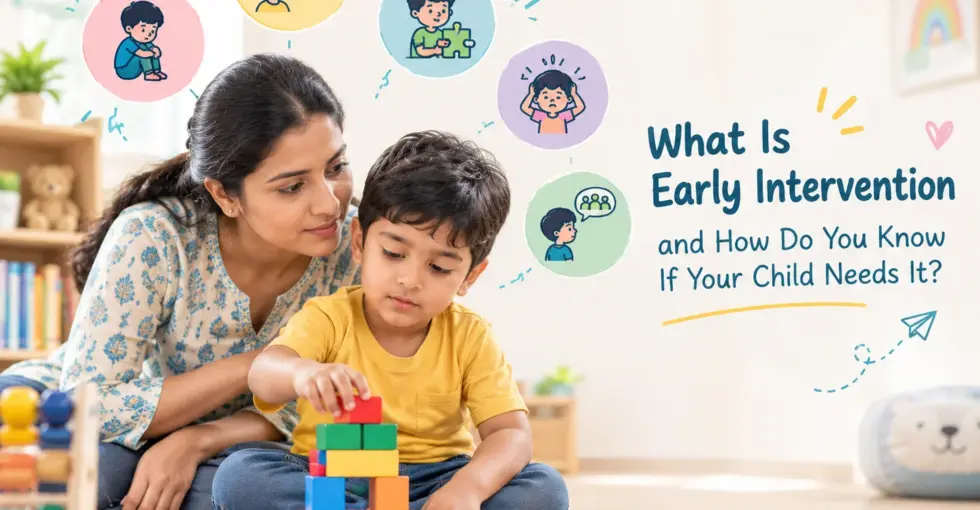

When a child takes longer to speak, struggles with everyday routines, appears unusually sensitive to sounds or has difficulty interacting with others, parents often hear:
“Give it time. They will grow out of it.”
Sometimes children do simply develop at different rates.
But sometimes waiting does not answer the most important question:
Is my child developing differently in a way that is beginning to affect everyday life?
This is where understanding early intervention becomes useful.
Early intervention means identifying developmental needs early and providing appropriate support when those needs begin affecting communication, movement, learning, social interaction, behaviour or daily functioning.
It does not automatically mean a child has autism.
It does not mean parents have failed.
And it does not mean every child who develops differently needs intensive therapy.
The purpose is to understand what the child can currently do, where they are finding things difficult and whether additional support could make everyday participation easier.
What Is Early Intervention?
Early intervention is developmental support provided during a child’s early years when there are concerns about areas such as:
- speech and language
- communication
- movement
- sensory processing
- learning
- social interaction
- behaviour
- self-care
- everyday participation
Depending on the child’s needs, support may include:
- speech therapy
- occupational therapy
- developmental intervention
- behavioural support
- special education
- parent coaching
- coordinated multidisciplinary services
The right starting point is usually assessment, not automatically enrolling the child in every available therapy.
Why Does Early Intervention Matter?
Early childhood is a period of rapid development.
During these years, children are learning foundational skills such as:
- communicating needs
- understanding language
- moving through their environment
- playing
- interacting with others
- feeding and dressing
- following routines
- beginning to learn independently
When one or more of these areas is consistently difficult, early support can help families understand the difficulty before it begins interfering more significantly with everyday participation.
The purpose should not be:
“Make the child catch up as quickly as possible.”
A better goal is:
Identify meaningful needs early and help the child build useful skills.
Early Intervention Is Not the Same as Early Diagnosis
This distinction is important.
A child can receive developmental support even if they do not yet have a formal diagnosis.
For example, parents may notice:
- delayed speech
- difficulty understanding language
- limited communication
- challenges with dressing or feeding
- unusual sensory responses
- difficulty playing with others
- poor motor coordination
- significant problems participating in preschool
The family may first need help understanding what is happening, rather than deciding what diagnosis applies.
An assessment may lead to:
- reassurance and monitoring
- targeted therapy
- a broader developmental evaluation
- hearing or medical assessment
- school-related support
- multidisciplinary intervention
How Do You Know Whether to Wait or Seek an Assessment?
Parents often struggle most with this question.
Instead of looking at one isolated milestone, consider four things.
1. Duration
Has the concern been present consistently rather than appearing only occasionally?
2. Functional Impact
Is it affecting communication, play, school readiness, relationships, self-care or everyday routines?
3. Difference Across Settings
Does the difficulty appear only at home, or do teachers and other caregivers notice it too?
4. Change Over Time
Is the child gradually progressing, staying at the same level or losing a skill they previously used?
A professional assessment becomes more useful when a difficulty is persistent, affects everyday life or involves a loss of previously acquired skills.
Developmental Concerns Can Appear in Different Areas

Early intervention is not only about speech delay.
Communication and Language
Parents may notice difficulty with:
- using words or gestures
- understanding instructions
- communicating basic needs
- combining words
- answering questions
- interacting conversationally
When communication is the primary concern, professional Speech Therapy assessment can help identify whether the difficulty involves speech sounds, expressive language, understanding language, social communication or another area.
Daily Living, Motor and Sensory Skills
Some children communicate well but find everyday tasks unusually difficult.
Parents may notice challenges with:
- dressing
- eating
- using utensils
- handwriting readiness
- fine-motor tasks
- coordination
- tolerating textures
- coping with noise
- transitions
- participating comfortably in routines
In these situations, Occupational Therapy may help assess functional, sensory and motor needs.
Learning and School Readiness
Another child may primarily struggle with:
- recognising concepts
- attention during structured tasks
- early academic skills
- classroom participation
- following learning routines
- learning at the expected pace
When learning itself is the major concern, Special Education Therapy may form part of an individualised support plan.
Autism-Related Developmental Needs
Autism can involve different combinations of:
- communication differences
- social interaction
- sensory processing
- behaviour
- flexibility
- play
- learning
- everyday functioning
No two autistic children require exactly the same therapy programme.
Parents seeking a broader overview can learn more about Autism Treatment and how different therapy disciplines may be combined based on functional needs.
One Concern Does Not Automatically Mean One Diagnosis
Parents sometimes search:
“My child does not respond to their name. Is it autism?”
or:
“My child is late to talk. Does that mean autism?”
A single behaviour rarely gives enough information to answer a developmental question accurately.
For example, delayed speech can occur for different reasons.
Difficulty responding may also relate to:
- hearing
- attention
- language understanding
- environment
- developmental differences
- other factors
This is why developmental assessment looks at the whole pattern, rather than one symptom in isolation.
What Are Some Signs That May Justify a Developmental Discussion?

Parents may consider speaking with a qualified professional when they repeatedly notice concerns such as:
Communication
- very limited attempts to communicate
- difficulty understanding age-appropriate everyday language
- limited gestures
- persistent speech or language concerns
- significant frustration when communicating
Social Interaction
- limited interest in shared play
- difficulty engaging with others
- limited back-and-forth interaction
- persistent difficulty participating socially
Motor or Everyday Skills
- difficulty using hands for age-appropriate tasks
- significant problems feeding or dressing
- poor coordination
- unusually high dependence during everyday routines
Sensory Responses
- intense reactions to ordinary sounds, touch, textures or movement
- sensory responses that repeatedly interfere with daily participation
Learning and Play
- difficulty learning through play
- repetitive patterns that significantly restrict participation
- challenges with age-appropriate preschool activities
The presence of one sign does not automatically indicate a developmental disorder.
Patterns, severity and functional impact matter.
Skill Loss Deserves Prompt Attention
One important distinction is delay versus regression.
A delay means a skill is developing more slowly.
Regression means the child was previously using a skill and then stopped or significantly reduced using it.
Examples might include:
- losing previously used words
- reduced social interaction
- losing an everyday skill
- a noticeable decline in abilities the child previously demonstrated
When parents observe meaningful skill loss, it is sensible to discuss it promptly with an appropriate healthcare or developmental professional rather than simply waiting.
What Does the Government of India Say About Early Intervention?
India’s Department of Empowerment of Persons with Disabilities describes early intervention as specialised support for infants and young children who are at risk of, have disabilities or experience developmental delays, together with their families.
The Government’s Cross-Disability Early Intervention Centres (CDEICs) are designed around multidisciplinary support, reflecting the fact that developmental concerns may involve more than one professional area.
Parents and professionals can review the official Cross-Disability Early Intervention Centres guidance from the Department of Empowerment of Persons with Disabilities.
The important takeaway for families is simple:
Early intervention is not one single therapy. It is a coordinated response to a child’s developmental and functional needs.
What Happens During an Early Developmental Assessment?

Parents often imagine assessment as a formal test where a child is expected to “perform.”
In practice, a developmental assessment may include several different sources of information.
Parent Interview
The professional may ask about:
- pregnancy and birth history
- developmental milestones
- communication
- behaviour
- play
- feeding
- sleep
- school or preschool
- medical history
- the family’s main concerns
Observation
The child may be observed while:
- playing
- communicating
- moving
- responding to instructions
- solving simple problems
- interacting with a caregiver
Developmental Skills
Depending on the concern, professionals may look at:
- communication
- motor skills
- sensory processing
- learning
- social interaction
- self-care
- adaptive functioning
Functional Impact
A useful assessment should also ask:
What is currently difficult in the child’s real life?
That question often matters more than simply identifying a delayed skill.
What Should Parents Bring to the First Assessment?
You do not need to prepare perfectly.
Useful information can include:
- child’s age
- main concern
- when you first noticed it
- words or communication methods currently used
- everyday skills
- sleep and feeding information
- preschool or teacher feedback
- previous reports
- hearing or medical information, if relevant
- examples of situations that are currently difficult
Short videos of naturally occurring behaviours may also be useful when the professional advises bringing them.
Which Therapy Should Start First?
There is no universal order.
Start with the difficulty having the greatest impact on the child’s everyday functioning.
If Communication Is the Main Barrier
A speech and language assessment may be useful.
If Sensory, Motor or Self-Care Skills Are the Main Barrier
An occupational-therapy assessment may be relevant.
If Learning Is the Main Concern
Special education or developmental assessment may be appropriate.
If Several Areas Are Affected
A multidisciplinary assessment may provide a clearer starting plan than independently booking several therapies.
The goal should be better-targeted support, not simply more therapy.
More Therapy Hours Do Not Automatically Mean Better Outcomes
Parents often search:
“How many hours of early intervention does my child need?”
There is no single number appropriate for every child.
The schedule may depend on:
- age
- developmental profile
- main goals
- therapy type
- ability to participate
- school schedule
- family routine
- progress
- recommendations from qualified professionals
Instead of focusing only on hours, ask:
- What is each session targeting?
- Why is this frequency recommended?
- How will progress be measured?
- Can skills be practised in everyday routines?
- When will the schedule be reviewed?
Therapy intensity should have a clear purpose.
Avoid Therapy Overload
Starting early does not mean filling every available hour with intervention.
Children still need:
- sleep
- free play
- family time
- outdoor movement
- school or preschool
- opportunities to simply be children
If a young child is attending multiple services, parents should ask:
- Does each therapy have a distinct purpose?
- Are professionals working toward coordinated goals?
- Is the schedule manageable for the child?
- Is progress actually being measured?
More appointments do not automatically mean a stronger developmental plan.
Early Intervention Goals Should Be Functional
A vague goal might be:
“Improve communication.”
A more useful goal could be:
“Child will use a word, gesture, picture or other agreed method to request help during everyday routines.”
Instead of:
“Improve fine motor skills.”
consider:
“Child will participate more independently in dressing by pulling up clothing with reduced assistance.”
Functional goals make therapy easier for parents to understand and easier for professionals to evaluate.
Progress Should Be Measured Against the Child’s Starting Point
Comparing the child constantly with other children can make progress difficult to recognise.
Instead ask:
What Could They Do Before?
Establish a baseline.
What Can They Do Now?
Look for measurable change.
How Much Help Do They Need?
Progress may mean doing the same skill with less prompting.
Is the Skill Appearing Outside Therapy?
A skill becomes more useful when it generalises to home, preschool or other everyday environments.
For example:
Therapy: child uses a picture to request water.
Home: child independently uses it at mealtime.
Preschool: child uses the same communication method with a teacher.
That is meaningful functional progress.
Parent Involvement Does Not Mean Becoming Your Child’s Therapist

Parents play an important role in early intervention, but home should not become a clinic.
The most useful strategies often fit naturally into routines.
Early Intervention Activities Parents Can Use at Home
During Meals
Offer simple choices:
“Apple or banana?”
Then pause.
The child might respond using:
- a word
- gesture
- pointing
- picture
- another appropriate method
During Play
Follow the child’s interest.
If the child is playing with a car, model simple useful language:
Car.
Go.
Stop.
Fast.
Communication becomes connected to something the child already enjoys.
During Books
You do not need to read every sentence.
Try:
- pointing to pictures
- naming objects
- making animal sounds
- pausing
- waiting for the child to indicate something
During Dressing
Allow the child to participate in manageable steps.
For example:
- choosing a shirt
- pulling up a sock
- pushing an arm through a sleeve
- putting clothes into a basket
The goal is participation and independence.
During Everyday Routines
Useful learning opportunities already exist during:
- bath time
- meals
- getting ready
- cleaning up
- outdoor play
- bedtime
Parents do not need dozens of specialised toys to support development.
Do Not Turn Every Interaction Into a Test
Parents naturally want to help, but repeated questions can become stressful.
Instead of constantly asking:
“What colour is this?”
“What is that?”
“Say ball.”
try modelling useful communication.
For example:
“Big ball!”
“Ball goes up.”
“Your turn.”
Children need opportunities to participate, not only opportunities to give correct answers.
School and Therapy Should Share Useful Information
As children begin preschool or school, developmental needs may appear differently outside the home.
Teachers may notice:
- communication difficulty
- sensory overload
- trouble following group instructions
- limited peer interaction
- motor difficulties
- learning concerns
With appropriate parent consent, useful communication between the therapy and school teams may help determine whether a skill is generalising beyond the clinic.
When Might a Child Need More Than One Professional?

A child may have difficulty in several developmental areas simultaneously.
For example:
- speech delay
- sensory difficulty
- weak fine-motor skills
- trouble with self-care
- preschool participation challenges
In that situation, more than one discipline may be useful.
But professionals should ideally work toward shared functional priorities.
Example:
Child participates more independently in the preschool morning routine.
Speech therapist:
supports understanding and communicating needs.
Occupational therapist:
supports dressing, sensory participation and motor skills.
Special educator:
supports classroom readiness and learning routines.
Different therapies can then work toward the same meaningful outcome rather than functioning as unrelated appointments.
How Often Should an Early Intervention Plan Be Reviewed?
A review can be useful when:
- goals are achieved
- progress stalls
- new concerns emerge
- preschool or school demands change
- the child develops new skills
- therapy frequency appears difficult to manage
- different therapies begin targeting the same thing
Early intervention should change as the child changes.
The same plan should not continue indefinitely without review.
What If an Assessment Says My Child Does Not Need Therapy?
That can also be a useful outcome.
An assessment does not automatically need to lead to treatment.
A professional may recommend:
- monitoring
- parent strategies
- preschool observation
- reassessment later
- another type of evaluation
The purpose of assessment is clarity, not automatically creating a therapy programme.
What If Parents and Professionals Disagree?
Parents know their child’s everyday patterns.
Professionals bring assessment and developmental expertise.
Both perspectives matter.
If something in the recommended plan is unclear, ask:
- Why is this therapy needed?
- What specific difficulty does it target?
- What is the baseline?
- What improvement should we look for?
- When will the plan be reviewed?
- Are there alternatives?
- What can we do at home?
Parents should understand the reason behind recommendations.
What Makes a Good Early Intervention Provider?
Parents can look for:
- appropriately qualified professionals
- a clear assessment process
- individualised goals
- multidisciplinary coordination when needed
- parent involvement
- measurable progress tracking
- regular reviews
- realistic expectations
- practical home guidance
Avoid services that promise guaranteed outcomes or fixed timelines for every child.
Development does not follow one identical schedule.
Early Intervention at Bright Horizon Child Development Center
Bright Horizon Child Development Center provides multidisciplinary child-development services across Punjab.
Support areas include:
- speech and language therapy
- occupational therapy
- autism-related intervention
- behavioural support
- sensory intervention
- special education
The stronger starting point is not:
“Which package should my child join?”
It is:
“Which area is currently making everyday life hardest for my child?”
That question can help guide the assessment and therapy plan.
Final Thoughts
Early intervention is not about racing against another child’s milestones.
It is not about turning every developmental difference into a diagnosis.
And it is not about automatically starting as many therapies as possible.
It is about recognising when a child is consistently finding communication, movement, learning, sensory processing, social interaction or everyday routines difficult and getting enough information to decide what support is appropriate.
Sometimes the next step is therapy.
Sometimes it is monitoring.
Sometimes it is another assessment.
And sometimes parents simply need practical strategies and reassurance.
The most useful early-intervention plan is therefore not the one with the most therapy hours.
It is the one that identifies meaningful needs, sets functional goals, measures progress and changes as the child develops.
Not Sure Whether Your Child Needs Early Intervention?
You do not need to know whether your child’s concern is speech, sensory, behavioural, learning-related or autism-related before asking for professional guidance.
For a more useful first discussion, parents can prepare:
- child’s age
- main developmental concern
- when it was first noticed
- current communication skills
- everyday self-care skills
- sensory concerns
- preschool or school feedback
- previous assessments, if available
- any loss of previously acquired skills
- the everyday situations that are currently hardest
Bright Horizon Child Development Center can use this information as a starting point to identify which assessment or professional discipline may be appropriate.
Contact Bright Horizon to Discuss an Early Developmental Assessment
Frequently Asked Questions
- What is early intervention?
Early intervention is support provided when a young child has developmental concerns involving communication, movement, learning, sensory needs, social interaction, behaviour or everyday functioning.
- Does early intervention mean my child has autism?
No. Early intervention can support many developmental needs and does not automatically mean that a child has an autism diagnosis.
- At what age can early intervention begin?
Support can begin when a meaningful developmental need is identified. The exact age and type of intervention depend on the child, programme and concern.
- Should parents wait if a child is a late talker?
Children develop at different rates, but persistent communication concerns are worth discussing with a qualified professional. An assessment can help distinguish between monitoring and a need for support.
- What is the difference between speech therapy and early intervention?
Speech therapy is one professional discipline. Early intervention is a broader approach that may involve speech therapy, occupational therapy, special education, behavioural support or other developmental services depending on the child’s needs.
- When might occupational therapy be recommended?
OT may be relevant when motor, sensory or everyday functional difficulties affect activities such as dressing, eating, handwriting readiness, play or participation in routines.
- When might special education be useful?
Special education may help when learning, concept development, preschool readiness or participation in structured educational activities is a primary concern.
- How many hours of early intervention does a child need?
There is no universal number. Frequency should be based on the child’s needs, goals, therapy type, participation, family routine and professional assessment.
- Does more therapy always mean faster progress?
No. Therapy should have clear goals and an appropriate intensity. Children also need rest, play, family time and opportunities to use skills naturally.
- Can parents practise early-intervention activities at home?
Yes. Everyday routines such as play, meals, books, dressing and bath time can provide natural opportunities to practise communication, independence and other skills.
- How should early-intervention progress be measured?
Progress should be compared with the child’s starting point and specific functional goals, including whether skills are becoming more independent and appearing outside therapy.
- What if my child loses a skill they previously had?
Meaningful loss of previously acquired developmental skills should be discussed promptly with an appropriate healthcare or developmental professional.
- Does every child who has an assessment need therapy?
No. An assessment may result in therapy, monitoring, parent strategies, another evaluation or reassurance depending on what is found.
- Can children need speech therapy, occupational therapy and special education together?
Yes, when several developmental areas are affected. However, each therapy should have a clear role and ideally contribute to coordinated functional goals.
- What should parents ask before starting early intervention?
Ask what the assessment identified, why a particular service is recommended, what goals will be targeted, how progress will be measured, what parents can do at home and when the plan will be reviewed.