
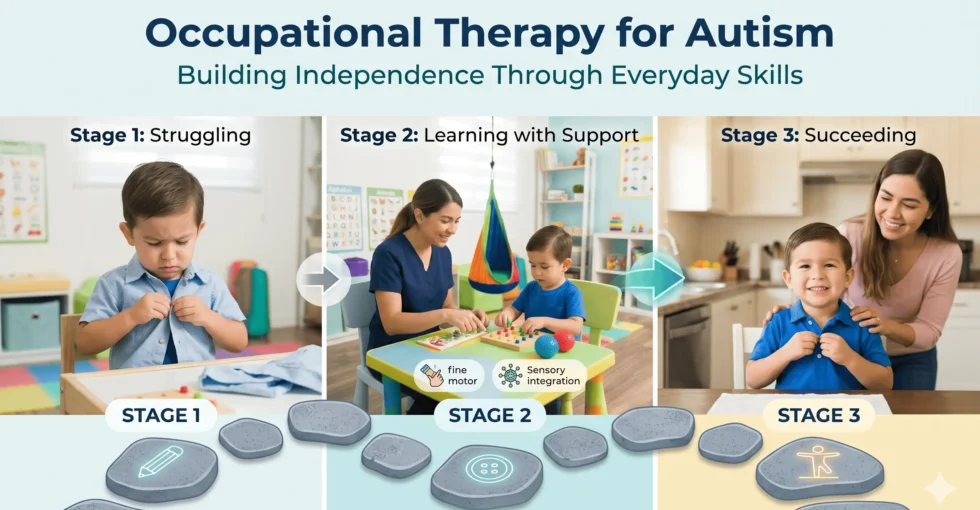

When parents first hear the words Occupational Therapy, many assume it has something to do with jobs or careers.
Then comes the obvious question: “My child is only 4 years old. Why would they need occupational therapy?”
The answer is surprisingly simple.
For children with autism, occupational therapy is not about work. It is about helping them develop the everyday skills needed to participate more confidently at home, in school, and in social situations.
Simple activities that many children learn naturally such as holding a pencil, buttoning a shirt, eating independently, sitting in class, following routines, managing emotions, or playing with peers can feel overwhelming for an autistic child.
This is where occupational therapy can make a meaningful difference.
With the right support, children can gradually build independence, confidence, and practical life skills that help them navigate the world more comfortably.
What Is Occupational Therapy for Autism?
Occupational therapy (OT) is a specialized intervention that helps children develop the physical, sensory, cognitive, and social skills needed for everyday activities.
For autistic children, occupational therapists focus on improving participation in daily life rather than simply teaching isolated skills.
The goal is not to “change” who the child is. The goal is to help them engage more successfully in activities that matter to them and their families.
An occupational therapist’s job is to figure out exactly where the gap is in motor coordination? Sensory processing? Both? and build a structured plan to close it, one functional skill at a time.
This matters more than it sounds like on paper. A child who struggles to hold a spoon isn’t just dealing with a feeding issue; they’re potentially facing embarrassment at school lunch, dependence on a parent at age six, and frustration that often comes out as a behavior problem rather than what it actually is a motor skill gap nobody addressed early enough.
Not sure if your child’s struggles point to a sensory issue, a motor issue, or both? Get a professional OT assessment with our certified therapists.
Why Do Many Children with Autism Need Occupational Therapy?
Autism affects more than communication and social interaction.
Many autistic children experience challenges with:
Sensory Processing
Some children become overwhelmed by sounds, lights, textures, smells, or crowded environments.
Others actively seek sensory input through movement, jumping, spinning, or touching objects.
Fine Motor Skills
Tasks that seem simple holding a spoon, tying shoelaces, colouring within lines, or writing letters may require significant effort.
Attention and Regulation
Many children struggle to remain seated, follow instructions, transition between activities, or regulate emotions.
Daily Living Skills
Activities such as brushing teeth, dressing, bathing, or eating independently may take longer to learn.
Without proper support, these challenges can affect confidence, school readiness, and family routines.
Concerned About Your Child’s Development?
Early intervention often leads to better long-term outcomes.
Speak with experienced occupational therapists and child development specialists at Bright Horizon Child Development Center.
Call: +91 9800990088
What a Real Occupational Therapy Session Actually Looks Like
One of the biggest misconceptions about therapy is that progress happens only inside the therapy room.
In reality, effective occupational therapy focuses on helping children succeed in their everyday environments.
Let’s look at some of the practical ways OT supports development.
The first session is to know your child’s strengths, challenges & daily needs
The therapist observes how your child moves, handles objects, reacts to different sensory input, and manages basic self-care tasks. They’ll also talk to you about daily routines, what frustrates your child most, and what a “good day” versus a “hard day” looks like at home. This builds the actual treatment plan not a generic template handed to every child who walks in.
Regular sessions are built around specific, functional goals, almost always disguised as play
A child working on hand strength might be “cooking” with playdough. A child working on bilateral coordination might be stringing beads onto a shoelace while making up a story about it. A child working on sensory regulation might start every session on a swing or with deep-pressure activities before moving to tabletop work, because a dysregulated nervous system can’t focus on fine motor tasks anyway regulation has to come first.
Progress is tracked against real goals, not vague impressions
A transparent therapist shows you exactly what’s being worked on and why “we’re targeting pincer grip this month because it’s the foundation for holding a pencil” is a very different conversation than “he’s doing okay.”
Curious what a personalised OT plan would look like for your child? Book a one-on-one consultation with our occupational therapists.
How Common Is Autism in India And Why That Number Keeps Changing
For years, India’s official autism prevalence estimate, based on the 2011 census, stood at around 1.3%. Researchers now believe this figure significantly underestimated the true number of children with autism due to limited screening facilities and lower awareness rather than a genuinely lower prevalence. A large community-based study conducted by the INCLEN Trust across five regions of India, involving nearly 4,000 children, reported a prevalence of approximately 1 in 100 children under the age of 10. More recently, a 2024 review suggested that around 1 in 65 children aged 2 to 9 years may be affected by autism spectrum disorder.
Studies have consistently shown that boys are diagnosed with autism nearly three times more often than girls, a pattern that has also been observed in Indian populations. The rise in reported cases does not necessarily mean autism is becoming more common. Instead, improved awareness, better access to screening, and increased acceptance of developmental evaluations are helping families receive timely diagnoses. As awareness continues to grow, more parents are seeking support and specialized care through facilities such as an Autism Centre in Ludhiana, ensuring children receive early intervention and appropriate therapies. If your child has recently been diagnosed, it is important to remember that autism is not rare many families are experiencing similar journeys, and increasing recognition means more children are receiving the support they need to thrive.
Occupational Therapy vs. Other Therapies — Where OT Fits In
Parents are often handed a list of recommended therapies without a clear explanation of what each one actually does, which adds confusion at an already overwhelming time.
- Occupational therapy focuses on fine motor skills, sensory processing, and independence in daily activities – dressing, feeding, handwriting, tolerating sensory environments like a classroom.
- Speech therapy focuses on communication, understanding language, forming words, building sentences, and social use of language.
- ABA therapy and behavioural modification target specific behaviour patterns, often used in coordination with OT for children who need both skill-building and behavioural support.
Special education addresses academic learning pace and method, often layered on top of therapeutic support rather than replacing it.
Most children on the autism spectrum benefit from more than one of these working together, not in isolation. A child who’s sensory-overwhelmed in class (an OT target) is also more likely to struggle with communication in that moment (a speech target) addressing both in a coordinated plan produces faster, more durable progress than treating them as unrelated issues.
Occupational Therapy in Ludhiana and Across Punjab: Why Families Choose Bright Horizon Child Development Center
As a dedicated unit of Apricus Health Care India Pvt Ltd, Bright Horizon Child Development Center provides a gold-standard infrastructure for comprehensive pediatric care across Punjab. We specialize in delivering unified, evidence-led interventions for children aged 2 to 15 years.Our center brings together certified pediatric experts to provide a synchronized care system under one roof:
- Occupational Therapy & Sensory Integration: Stabilizing sensory processing issues and building vital daily functional skills.
- Autism Therapy & ABA Frameworks: Utilizing structured Applied Behavior Analysis to build communication, tracking metrics, and reducing negative behavioral triggers.
- Speech Therapy & Special Education: Addressing critical expressive-receptive language gaps and cultivating essential academic readiness.
Every child at Bright Horizon receives a highly personalized treatment plan backed by secure digital therapy records, ensuring total transparency, precise adjustments, and data-driven results for your family.
Not Sure Whether Your Child Needs Occupational Therapy?
A professional developmental assessment can provide clarity and guidance.
Speak with our experts today: tel:+919800990088
Final Thoughts
Occupational therapy is not about teaching a child to fit into a box. It is about helping them build the skills they need to participate more comfortably and confidently in everyday life.
For an autistic child, learning to communicate needs, manage sensory challenges, write independently, follow routines, or complete daily tasks can be life-changing achievements.
If your child is somewhere in the middle of all this diagnosed but untreated, suspected but unconfirmed, or already in therapy somewhere but not seeing real progress the next right step is usually the same: get a clear, individual assessment from someone qualified to give you a straight answer, not a generic program.
Speak with a certified pediatric specialist today to build a customized, goal-based therapy roadmap.
Contact Bright Horizon: Call us directly at +91 9800990088 to schedule your initial clinical evaluation.