

One of the hardest moments for any parent is noticing that their child seems to be developing differently from other children.
Maybe your toddler avoids eye contact.
Maybe they don’t respond to their name consistently.
Maybe they’re not speaking yet, or they prefer playing alone.
At first, many parents tell themselves:
“Let’s wait a few more months.”
“Every child develops differently.”
“Maybe they’re just late bloomers.”
And while every child does develop at their own pace, there is one fact that child development experts consistently agree on: When autism is identified early, starting therapy early can make a significant difference in a child’s development.
This is why early autism intervention India has become one of the most important topics in child healthcare today. The years before age 5 are not just another stage of childhood. They are a unique window of brain development that may never be repeated in exactly the same way.
Let’s understand why.
Why the First Five Years Matter So Much
To understand why waiting until primary school is a devastating tactical error, we have to look under the hood at childhood neurobiology.
During the first 36 months of life, a child’s brain undergoes a massive explosion of growth, building roughly 700 new neural connections every single second. By the time they turn two, the physical brain has already reached nearly 80% of its adult size. This hyper-rapid development is driven by a phenomenon called neuroplasticity – the brain’s natural ability to physically reshape its pathways based on external experiences and therapeutic inputs.
The first five years of life are when these neural pathways develop at an incredible pace.
Children learn:
- Communication
- Social interaction
- Problem-solving
- Emotional regulation
- Play skills
- Daily living skills
For children with autism, some of these developmental pathways may need additional support and guidance.
This is where early therapy becomes valuable. The earlier intervention begins, the more opportunities therapists have to strengthen important developmental skills during these critical years.
Wondering where your child’s development currently stands? Get a professional developmental screening with our team.
What Is Early Autism Intervention?
Early intervention refers to therapies and support services provided during the early developmental years, typically before the age of five.
The goal is simple: Help children develop foundational skills that support learning, communication, independence, and social participation.
Depending on a child’s needs, intervention may include:
- Autism Therapy
- Speech Therapy
- Occupational Therapy
- ABA Therapy
- Sensory Integration Therapy
- Behavioural Intervention
- Special Education Therapy
Rather than focusing on one challenge, early intervention takes a holistic approach to development.
Recognizing the Signs Early: What to Actually Watch For
Autism can often be identified earlier than most parents expect sometimes signs are visible as early as 12 to 18 months, well before many families consider an evaluation. Here’s what genuinely warrants a conversation with a pediatrician, not just normal toddler variation:
- Limited Eye Contact – Children may rarely look toward people during interaction.
- Delayed Speech and Language – Communication milestones may not develop as expected.
- Not Responding to Name – A child may seem unaware when called.
- Repetitive Behaviours – Hand flapping, spinning objects, lining up toys, or repetitive movements may be observed.
- Limited Social Interaction – Children may prefer solitary activities and show less interest in peer engagement.
- Sensory Sensitivities – Certain sounds, textures, lights, or environments may cause distress.
Experiencing one or more of these signs does not automatically confirm autism. However, early developmental assessment can provide valuable clarity.
Concerned About Your Child’s Development?
The earlier concerns are evaluated, the sooner families can access appropriate support.
Speak with our child development experts today: tel:+919800990088
Why Early Autism Therapy Benefits Are So Significant
Many parents ask: “Will therapy really make a difference if we start now?”
While every child’s journey is unique, research and clinical experience consistently show that early intervention often leads to stronger developmental outcomes.
Let’s explore why.
Communication Skills Develop Faster
Communication is one of the most common challenges associated with autism.
When therapy begins early, children have more opportunities to learn:
- Expressive language
- Understanding instructions
- Social communication
- Conversation skills
- Non-verbal communication
The earlier these foundations are built, the easier it becomes for children to engage with family members, teachers, and peers.
Social Skills Improve Naturally Over Time
Social interaction is not something children simply “pick up.” It develops through guided experiences and repeated opportunities.
Early therapy helps children learn:
- Turn-taking
- Joint attention
- Eye contact
- Peer interaction
- Play skills
These abilities often support stronger relationships throughout childhood.
Better School Readiness
Many parents focus on academics. However, successful school participation begins long before learning numbers and letters.
Children need:
- Attention skills
- Sitting tolerance
- Following instructions
- Emotional regulation
- Communication abilities
Early intervention helps build these foundational skills before formal schooling begins.
Greater Independence in Daily Life
Simple daily activities can be surprisingly difficult for some autistic children.
Therapy may help children become more independent with:
- Dressing
- Eating
- Personal hygiene
- Following routines
- Self-care activities
These skills reduce dependency and increase confidence over time.
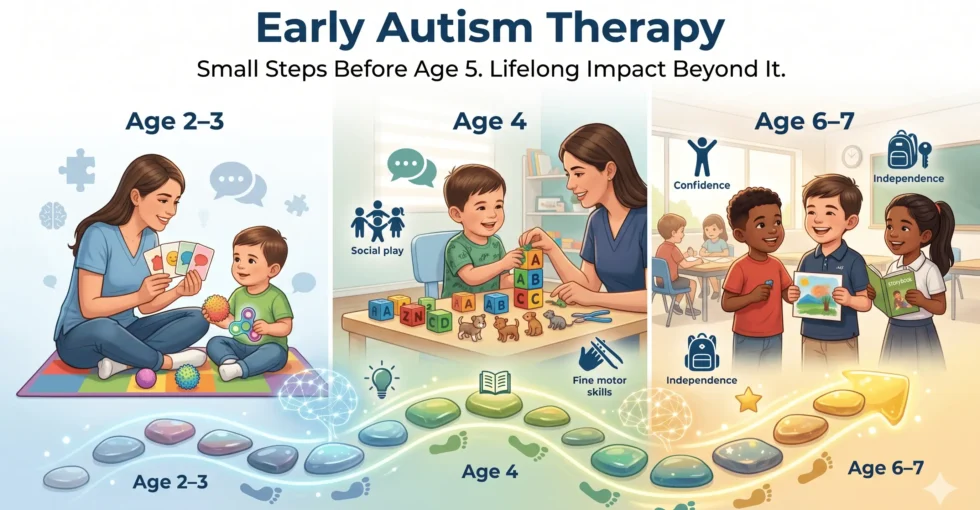
What Changes by School Age If Intervention Starts Early
This is the part that genuinely matters for your child’s longer-term trajectory, and it’s worth being concrete about it rather than vague.
Children who receive consistent, early, structured intervention generally enter school with stronger functional communication meaning they can express needs, follow classroom instructions, and engage with peers at a level that makes mainstream or inclusive schooling realistically achievable for many. They typically need less intensive support over time, because foundational skills built early reduce how much catch-up work is needed later.
And critically, behavioral challenges that often stem from frustration meltdowns from not being understood, sensory overwhelm in a classroom tend to be meaningfully reduced, because the underlying communication and regulation gaps were addressed before they became deeply ingrained coping patterns.
Children who start intervention later say, at 6 or 7 absolutely still make real, valuable progress. This isn’t a story about a closing door. But research consistently shows that the same amount of therapeutic effort, applied earlier, tends to produce larger and more durable gains than the identical effort applied later. Earlier isn’t a guarantee. It’s a meaningfully better set of odds.
Introducing Bright Horizon Child Development Center
If you’re searching for an autism centre in Ludhiana or an early intervention center in Jalandhar, here’s what genuinely separates strong early intervention from a generic program.
A center built for toddlers specifically not a downsized version of a program designed for older children matters enormously, since the right approach at age 2 looks structurally different from the right approach at age 8. Heavy parent involvement and training should be a core part of the program, not an afterthought, since a toddler’s progress is shaped far more by daily home interactions than by weekly clinic hours alone.
Coordinated, multi-disciplinary planning speech, OT, and behavioral support working from one shared plan rather than three disconnected providers produces faster, more consistent gains than fragmented care. And transparent, trackable goals let you actually see what’s being worked on, rather than relying on vague reassurance.
Operating as a premier unit of Apricus Health Care India Pvt Ltd, Bright Horizon Child Development Center delivers an integrated, clinical network of pediatric support across Punjab. We provide comprehensive, goal-driven interventions specifically designed for children aged 2 to 15 years.
Our ecosystem brings together leading clinical disciplines under a single, cohesive framework:
- Autism Therapy & ABA Frameworks: Utilizing positive reinforcement models to build essential verbal behaviors and reduce everyday communication barriers.
- Speech & Occupational Therapy: Bridging expressive language gaps while building fine motor skills and sensory regulation.
- Special Education & Behavioral Modification: Shaping classroom readiness and functional social skills to foster long-term independence.
Every milestone at Bright Horizon is mapped through cloud-based digital therapy records. This provides families with completely transparent, data-backed insight into their child’s unique developmental progress.
Considering autism therapy for your 2 or 3-year-old in Punjab? Speak directly with our certified therapists, call +91 98009 90088 or book an early assessment.
Build Your Child’s Adaptive Roadmap
The first five years of life offer an extraordinary opportunity for learning, growth, and development. For children with autism, early intervention is not about rushing childhood.
It is about giving children access to the support they need during one of the most important periods of brain development.
Protect your child’s critical developmental window by scheduling a structured diagnostic consultation with our certified pediatric panel.
Connect with Bright Horizon: Call us directly at +91 9800990088 to establish your personalized care plan.