
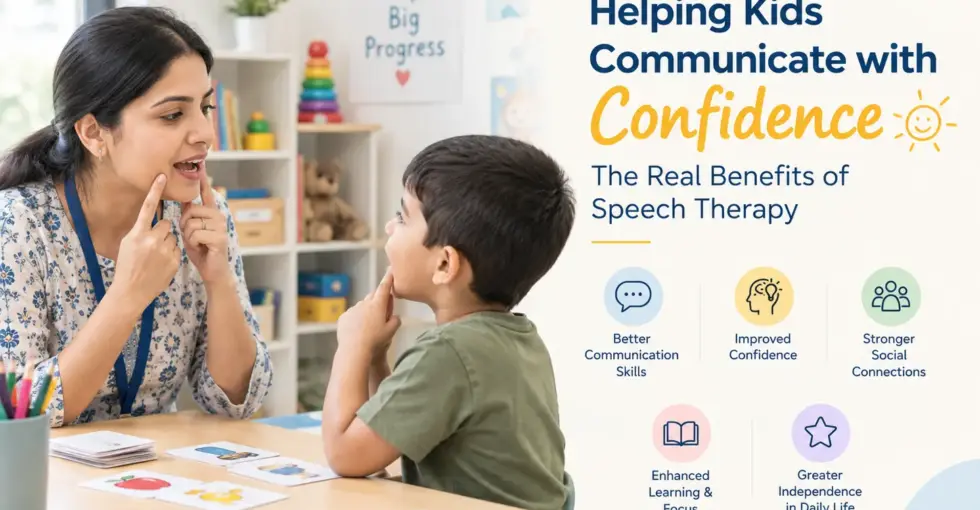

When a young child struggles to express what they want, everyday moments like asking for a snack, telling you about their day, or playing with kids at the park often turn into overwhelming meltdowns. You might catch yourself wondering: Is this just a normal phase? Will they naturally outgrow it once school starts? Or does my child need speech therapy right now?
Communication isn’t just about uttering words; it’s the foundation for emotional health, making friends, and building self-confidence. Understanding the true benefits of speech therapy helps parents move past the “wait-and-see” stress and take confident steps toward their child’s future.
We’ll cover what speech therapy genuinely does for a child’s development, what the research says about whether it works, what a therapist actually does in a session, how many sessions you’re realistically looking at, and what it costs in India, because cost is a real concern and pretending it isn’t doesn’t help anyone.
What Does a Speech Therapist Actually Do?

Many parents assume a speech session involves sitting at a small desk while a therapist forces a child to repeat sounds over flashcards for an hour. Modern speech-language pathology is nothing like that.
For toddlers and young children, certified therapists use play-based, naturalistic strategies. They turn real-world interactions like building Lego towers, watching interactive stories, or sharing toys into communication triggers.
When parents ask, “What does a speech therapist do for autism?” The focus expands beyond vocal output. For neurodivergent children, therapists target functional communication teaching kids how to use pointing, gesture systems, picture exchange cards (PECS), or speech devices to express needs and cut down on frustration-driven meltdowns.
What the research also confirms, and most clinic content skips, is that intensity and consistency matter enormously. A randomised controlled trial comparing in-person speech therapy to parent-supported digital programs found significantly better speech production outcomes for children who received in-person sessions with a qualified therapist, versus those who relied on app-based support or general advice alone. The platform doesn’t replace the person.
So yes — speech therapy works. Not as a magic switch, but as a structured, evidence-backed process that produces measurable changes in communication ability when delivered consistently by a qualified professional.
When Should You Actually Take Your Child for Speech Therapy?
There’s no single right age: but there are clear, honest signals worth knowing.
If your child is not saying single words by 18 months, not combining two words by age 2, or not easily understood by familiar people by age 3, those are meaningful flags worth getting a professional opinion on rather than waiting through.
The “wait and see” approach has a real cost: speech and language development builds layer by layer, and gaps in earlier layers make later layers harder. A child who doesn’t develop a strong verbal vocabulary before school often struggles with reading because decoding written words depends on a foundation of spoken sound-to-meaning connections that should have been built in the toddler years.
Beyond age milestones, there are subtler signs parents often dismiss or attribute to personality. A child who gets significantly more frustrated than peers when trying to communicate, a child who relies heavily on pointing and pulling instead of words well past age 2, a child who is very quiet in groups but communicates differently at home these patterns are worth raising with a speech therapist rather than filing under “she’s just shy.”
The honest answer to “does my child need speech therapy” is: if you’re genuinely unsure, an evaluation clarifies that. It’s not a commitment to a program; it’s a professional opinion that either confirms a concern or rules it out, and both outcomes are useful.
4 Major Benefits of Speech Therapy for Young Children
Addressing speech and language development in early childhood does far more than just improve pronunciation. The ripple effects positively impact every area of your child’s life:
- Dramatically Reduces Communication Meltdowns: When a child can’t explain that their stomach hurts or that they want a specific toy, they resort to crying or throwing things. Speech therapy gives them functional tools (words, signs, or visuals) to communicate instantly.
- Builds Social Confidence & Friendships: Speech clarity helps kids feel safe speaking up in groups, sharing toys, and making friends without fear of being misunderstood or teased.
- Boosts School Readiness & Reading Ability: Early speech processing directly impacts literacy. Kids who learn to identify and manipulate speech sound early transition into reading and writing much smoother.
- Strengthens Oral-Motor Muscles: Speech therapy helps children build the tongue, jaw, and lip muscle coordination needed for clear speech output, swallowing, and proper chewing mechanics.
- Parent Reality Check: Is speech therapy really effective? Yes, clinical data confirms that early intervention between ages 2 and 5 produces the fastest, most permanent results thanks to peak brain neuroplasticity during early childhood.
Wondering if your child is hitting their speech milestones?
Don’t spend hours searching online forums. Get clear, professional guidance from certified pediatric specialists.
Call Our Helpline: +91 9800990088
When to Take a Child for Speech Therapy: Checklist

Every child develops at their own rate, but waiting too long can create unnecessary learning gaps. Consider seeking a professional assessment if you notice these red flags:
- By 18 Months: No babbling, doesn’t respond to their name, or uses zero communicative gestures (like pointing or waving bye-bye).
- By 2 Years: Uses fewer than 50 individual words and doesn’t spontaneously put two words together (e.g., “want water” or “go park”).
- By 3 Years: Relies heavily on grunting to communicate, or family members struggle to understand more than half of what the child says.
- At Any Age: Stutters frequently, struggles to swallow food properly, or suddenly stops using words they previously mastered.
Speech Therapy Is Not Just “Repeat After Me”
Many parents remember speech therapy as sitting across a table and repeating difficult words.
Today’s child-focused therapy can be much more interactive. A therapist might use toys, stories, picture books, pretend play, songs, games, or the child’s favourite interests to create opportunities for communication.
Why? Because children communicate more naturally when they are interested in what they’re doing.
If a child loves cars, for example, a therapist can use that interest to practise requesting, describing, answering questions, taking turns, and building vocabulary. Therapy becomes part of play rather than feeling like another school lesson.
How Many Sessions for Speech Therapy Will My Child Need?
A common question parents ask is: How long will this take, and is speech therapy expensive?
The total number of sessions depends heavily on the root cause—whether it’s a minor articulation fix or a deeper developmental delay:
| Challenge Severity | Estimated Weekly Frequency | Typical Timeline Frame |
| Mild Articulation / Sound Errors | 5 to 6 sessions per week | 3 to 6 months |
| Moderate Language Delay | 5 sessions per week | 6 to 12 months |
| Autism-Related Communication Gap | Regular & intensive, multidisciplinary sessions | 12+ months phased program |
When viewed as an early investment, speech therapy saves parents from years of specialized academic tutoring and behavioral therapy down the road.
Give Your Child the Power to Express Themselves
Early speech support turns frustration into clear, confident communication. Consult a Certified Specialist: Call +91 9800990088 to reserve a consultation slot today.
What Makes a Good Speech Therapy Center?
Searching for a speech therapy center for excellence shouldn’t mean looking only for a fancy clinic. Look for a team that understands children and communicates clearly with parents.
A strong center should offer individualized assessments, qualified therapists, measurable goals, regular reviews, and practical guidance for home. It is also useful when speech therapy can connect with other developmental services when necessary.
For example, a child with autism may benefit from a combination of speech therapy, occupational therapy, behavioural intervention, and educational support.
Families often prefer therapy that is accessible enough to attend consistently.
Speech Therapy Support Across Punjab
Bright Horizon Child Development Center provides services across multiple Punjab locations, allowing parents to seek support closer to home.
Families in Jalandhar who notice speech delay, unclear pronunciation, language difficulties, stammering, or social communication concerns can learn more about Speech Therapy in Jalandhar.
For families searching in Ludhiana, the centre also provides Speech Therapy in Ludhiana with child-focused assessment and personalised communication goals.
Parents in and around Amritsar can explore Speech Therapy in Amritsar when they need professional support for a child’s speech, language, or communication development.
The most important factor is not simply choosing the nearest centre. Parents should also consider therapist qualifications, individualised assessment, consistency, progress reviews, and how clearly the therapy team communicates with the family.
Why Families Choose Bright Horizon Child Development Center
Bright Horizon Child Development Center, a unit of Apricus Health Care India Pvt Ltd, provides multidisciplinary developmental care for children aged 2 to 15 years across Punjab.
Our services include:
Autism Therapy | Speech Therapy | Occupational Therapy | ABA Therapy | Sensory Integration | Behavioural Modification | Special Education
Our approach focuses on the individual child rather than a one-size-fits-all program.
Families receive:
- Expert certified therapists
- Personalized treatment plans
- Goal-based therapy sessions
- Digital therapy records
- Transparent progress tracking
- Coordinated developmental support
The aim is simple: help children communicate, participate, learn, and become more independent in everyday life. If your child needs communication support, our team can first understand their needs and then recommend the appropriate next step.
Speak with our experts: +91 98009 90088
Will Speech Therapy Help My Child? The Honest Answer
Most parents want someone to simply say, “Yes, speech therapy works.”
The more accurate answer is that many children with speech and language difficulties show measurable improvement with speech and language therapy, but outcomes vary from child to child.
In 2024, data collected through the RCSLT Online Outcome Tool (ROOT) from 49 providers across the UK found that 79% of children and young people showed improvement in at least one of three measured areas following speech and language therapy: the extent of their speech and language needs, their ability to communicate, or their participation in everyday activities.
That’s roughly 8 in 10 children in the dataset.
However, this is outcome data, not a guarantee that therapy will produce the same result for every child. The type, intensity and consistency of support can also vary depending on the child’s individual needs.
If you’re concerned about your child’s speech or language development, starting the conversation with a qualified speech and language professional can help you understand what support may be appropriate.
Our certified therapists at Bright Horizon Child Development Center are available for a full speech and language assessment; children aged 2 to 15, across Punjab. Book directly or call +91 98009 90088.
Conclusion
Speech therapy isn’t about making every child speak in exactly the same way. It’s about helping a child communicate more successfully.
- For one child, success may mean saying a first word.
- For another, it may mean asking for help.
- For another, it may mean having a conversation without feeling frustrated.
Those milestones matter.
If you’re wondering “does my child need speech therapy?”, you don’t have to figure it out alone. A professional assessment can give you a clearer picture of your child’s communication skills and what support, if any, would be useful.
At Bright Horizon Child Development Center, we focus on practical goals, individualized care, and keeping parents informed throughout the process.
Have questions about your child’s speech or language development?
Call Bright Horizon Child Development Center: +91 98009 90088
Frequently Asked Questions
Will speech therapy help my child?
It can help children with a range of speech, language, communication, and fluency difficulties. The likely benefit depends on the child’s specific needs, therapy goals, and consistency of support.
Is speech therapy really effective?
Yes, speech-language therapy can be effective for many communication difficulties. Results vary between children, and therapy should be based on an individualized assessment rather than a guaranteed outcome.
When should I take a child for speech therapy?
Consider an assessment when you notice persistent difficulty with speech, understanding language, expressing needs, pronunciation, fluency, or social communication.
Does every child with delayed speech need therapy?
No. Some children develop language later and catch up naturally. A professional assessment can help determine whether your child’s communication development needs additional support.
What does a speech therapist do for autism?
A speech therapist can support functional communication, receptive and expressive language, social communication, conversation, speech sounds, and alternative communication methods when appropriate.
How many sessions for speech therapy does a child need?
There is no fixed number. Frequency and duration depend on the child’s needs, goals, progress, and recommendations from the treating professional.
How quickly will my child start talking after speech therapy?
There is no reliable universal timeline. Some children show changes relatively early, while others require longer support. Progress should be measured against individualized communication goals.
Can speech therapy help a child who already talks?
Absolutely. Therapy can help with pronunciation, vocabulary, sentence formation, fluency, social communication, conversation skills, and understanding language.
Is speech therapy expensive?
Costs vary by therapist, location, session length, and treatment needs. Parents should compare the quality and transparency of care rather than looking only at the lowest fee.