
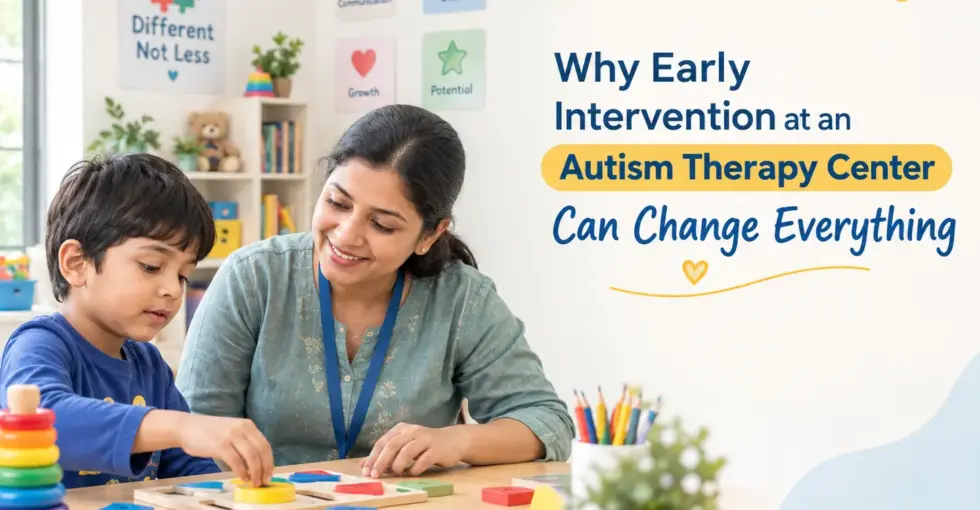

When parents first suspect their child might be on the spectrum, their minds race with tough questions: Is there any cure for autism? Can therapy help with autism? How much difference can an autism therapy center really make?
Hearing that your child has developmental differences can feel like stepping onto unfamiliar ground. But here is the truth that every parent needs to hear early on: early intervention at a specialized center isn’t about “fixing” a child. It is about building a bridge between how their unique brain processes the world and the skills they need to navigate everyday life with confidence.
One thing is clear: when a child has developmental differences or autism-related needs, getting the right support early can make daily life easier and help build important skills over time.
An experienced autism therapy center can help parents understand their child’s needs, set practical goals and choose therapies based on the child’s individual strengths and challenges.
The Reality Check: Is There Any Cure for Autism?
Let’s clear up a major myth right away: there is no “cure” for autism and there doesn’t need to be. Autism Spectrum Disorder (ASD) is a natural neurological variation, not a disease.
However, asking “can therapy help with autism?” gets an overwhelming yes from decades of clinical research. While therapy doesn’t change who your child is, starting early at an autism therapy center drastically alters their developmental trajectory.
Research suggest that children who begin intensive therapy before age 3 show significant gains in language development, cognitive flexibility, and daily adaptive skills compared to those who start later. Toddler brains possess peak neuroplasticity, the ability to form new neural connections rapidly, making early childhood the most effective window to build life-changing communication habits.
What Is an Autism Treatment Center, Really?

An autism treatment center isn’t one thing, the term covers a wide range of setups from single-therapist clinics to multidisciplinary developmental centers offering several coordinated therapies under one roof.
What distinguishes a strong autism therapy center from a generic one isn’t the name on the sign. It’s whether the center starts with a real individual assessment before recommending any therapy, whether multiple disciplines (speech, occupational therapy, ABA, behavioural support) work from a shared plan rather than in isolation, whether parents are genuinely trained and involved rather than handed a report and told to wait, and whether progress is tracked against specific, visible goals rather than vague impressions.
Instead of driving back and forth between isolated private clinics, a multi-specialty center combines all the necessary therapies for children on the spectrum into a single, cohesive plan:
- Autism Therapy for Toddlers: Early play-based interventions focused on joint attention, responding to names, and reducing early developmental frustration.
- Autism Therapy for Social Skills: Structured group sessions where kids learn parallel play, turn-taking, sharing, and reading non-verbal social cues.
- Autism Therapy for Behavior: Positive reinforcement plans that replace self-injurious habits or tantrums with safe, functional ways to express feelings.
Confused about your child’s milestones?
You don’t have to navigate this journey alone. Talk to a certified developmental specialist today. Call Our Helpline: +91 9800990088.
What Are the Core Therapies for Autism?
Every child’s sensory profile is different, which is why a one-size-fits-all approach fails. A comprehensive center combines several evidence-based therapies for autism:
| Therapy Type | Focus Area | Real-World Impact |
| Applied Behavior Analysis (ABA) & Behaviour Modification Therapy | Behavioral patterns & learning steps | Helps kids learn daily routines, follow instructions, and manage frustration. |
| Pediatric Speech Therapy | Building receptive Language, Improving Expressing Skills, Vocal Clarity, PECS, & language comprehension | Moves children from crying or grunting to using words or visual cards for needs. |
| Occupational & Sensory Integration (OT) | Fine motor control & Rebalancing sensory processing | Calms fight-or-flight reactions to loud noises, bright lights, or textured clothing. |
| Special Education Therapy | Cognitive concepts & school readiness | Prepares neurodivergent children to transition into mainstream classrooms. |
Give Your Child the Advantage of Early Intervention
Starting therapy early turns daily challenges into achievable milestones.
Book a Consultation Today: Call +91 9800990088 to set up a comprehensive evaluation.
Autism Therapy for Kids Should Be Individual, Not “One Plan for Everyone”

Imagine two children of the same age. One child speaks in short sentences but struggles with social interaction. The other child does not use spoken language consistently but communicates through gestures and has strong visual learning skills.
Giving both children exactly the same therapy plan would not make sense. This is why autism therapy for children should start with understanding the child’s individual needs.
For families seeking Autism Treatment in Ludhiana, Bright Horizon’s Autism Centre in Ludhiana provides personalised support across communication, behaviour, social skills, and related developmental needs.
The center supports children from 2 to 15 years of age through a range of services, including autism therapy, speech therapy, occupational therapy, ABA therapy, sensory integration, behavioural modification and special education.
The aim is to give families a clearer picture of what their child needs and how therapy can support those needs.
Autism Therapy for Social Skills: Why Everyday Interaction Matters
Social skills are not just about making eye contact or saying hello. For an autistic child, social communication can involve many different skills:
- Taking turns during play
- Understanding another person’s perspective
- Asking for help
- Starting or continuing an interaction
- Understanding social cues
- Joining group activities
- Responding appropriately to others
Autism therapy for social skills should therefore focus on practical situations that matter to the child.
For example, instead of practising conversation only at a therapy table, a therapist may use games, pretend play or real-life situations to build communication and interaction skills. The more meaningful the situation, the easier it can be for a child to use the skill outside therapy.
Autism Therapy for Behavior: Look at the “Why”
Parents often search for autism therapy for behavior when their child has frequent meltdowns, aggression, self-injury, refusal, repetitive behaviours or difficulty following routines.
But behaviour is communication in many situations. A child may scream because they cannot explain that something hurts.
- They may refuse an activity because the sensory environment is overwhelming.
- They may become upset because a familiar routine suddenly changed.
- They may hit because they do not yet have another way to communicate frustration.
This is why a thoughtful therapy plan should look at the reason behind the behaviour, not just the behaviour itself. The goal should be to build safer, more effective ways for the child to communicate and cope.
Bright Horizon: Premier Care Across Punjab
Finding an autism therapy center that offers top-tier clinical standards alongside genuine empathy can feel overwhelming for parents. Bright Horizon Child Development Center (a unit of Apricus Health Care India Pvt Ltd) provides world-class pediatric care across Punjab. For families in Jalandhar and across Punjab, Special Education Therapy can support personalised learning goals, school readiness, academic skills, and individual education planning when appropriate.
Supporting children aged 2 to 15 years, Bright Horizon delivers a completely transparent, goal-oriented experience for families seeking autism therapy for kids:
- RCI-Certified Therapists: Expert behavioral analysts, speech pathologists, occupational therapists, and special educators work in direct collaboration.
- Personalized Treatment Plans: Programs built around your child’s specific strengths, fixations, and sensory preferences.
- Digital Therapy Records: View visual progress charts, milestone updates, and daily session notes directly from your smartphone.
- Integrated Multi-Center Network: Gold-standard therapy accessible across major hubs, including specialized care in Ludhiana, Jalandhar, and surrounding regions.
Can Parents Be Part of the Therapy Process?

Absolutely. Parents are not just observers.
You spend far more time with your child than any therapist does. Simple strategies used consistently at home can support the skills being practised during therapy.
This does not mean parents need to become therapists. It means understanding what your child is working on and knowing how to support communication, routines, play and independence during everyday moments.
That partnership can make therapy more meaningful.
The Right Time to Ask for Help Is When You Have a Concern
Parents often wait because they hope their child will “catch up.” Sometimes they do. But if developmental concerns are continuing, you don’t have to choose between panic and waiting.
You can simply ask for professional guidance. An assessment can give you a clearer understanding of your child’s strengths, needs and possible next steps.
Early intervention is not about changing who your child is. It is about giving your child the support they need to communicate, participate, build independence and feel more confident in everyday life.
If you’re looking for an autism therapy center in Punjab for your child, Bright Horizon Child Development Center can help you discuss your concerns and understand the available support.
Call +91 98009 90088 to speak with the team. Because sometimes, the biggest change starts with one simple step: asking for help.
Frequently Asked Questions
My child was just diagnosed with autism, where do I even start?
Start with a comprehensive developmental assessment at a qualified multi-disciplinary center, before committing to any specific therapy type. The assessment tells you which areas need the most support and in what order — which means you avoid paying for the wrong thing first and then course-correcting later. An assessment is the least overwhelming, most useful first step, even when everything else feels overwhelming.
Is there any cure for autism available in India?
No and this applies globally, not just in India. There is no cure for autism spectrum disorder. Parents in India sometimes encounter claims for treatments like stem cell therapy, homeopathy, or specific dietary protocols as “cures” ; none of these have credible clinical evidence behind them, and some carry real risks. The strongest evidence base remains with structured early behavioral and developmental intervention: ABA, speech therapy, occupational therapy, and sensory integration, delivered early and consistently.
Is autism therapy worth starting early?
Early intervention can provide children with additional support while important developmental and communication skills are emerging. It does not guarantee a particular outcome, but starting appropriate support earlier can give children and families more opportunities to practise useful skills.
Is there any cure for autism?
There is no scientifically established cure for autism. Therapy and educational support focus on communication, independence, social participation, learning, behaviour and quality of life.
What are the therapies for autism?
Depending on the child’s needs, support may include speech therapy, occupational therapy, behavioural interventions, ABA-based approaches, sensory-focused occupational therapy and special education. The right combination depends on an individual assessment.
Can therapy help with autism?
Yes. Therapy can help many autistic children build communication, social, learning, self-care and coping skills. Results vary from child to child, so goals should be personalised and progress should be monitored over time.
Is autism therapy for toddlers too early?
No, when therapy is appropriate and delivered in an age-appropriate way. Support for toddlers should be engaging, play-based where suitable and focused on meaningful developmental skills rather than putting academic pressure on the child.
Will my child have to attend therapy forever?
Not necessarily. Therapy needs can change as a child develops. Some children may need intensive support for a period, while others may benefit from ongoing or occasional support. The plan should be reviewed based on the child’s progress and current needs.
Can autism therapy improve social skills?
Therapy can support specific social communication skills such as turn-taking, joint play, initiating interaction, responding to others and communicating needs. Progress depends on the child’s individual profile and the goals being addressed.
What should I do if my child has frequent meltdowns?
Start by trying to understand what is happening before and during the meltdown. Communication difficulties, sensory overload, frustration, anxiety, pain and changes in routine can all play a role. A qualified therapist can help assess the pattern and develop safer ways for your child to communicate and cope.