
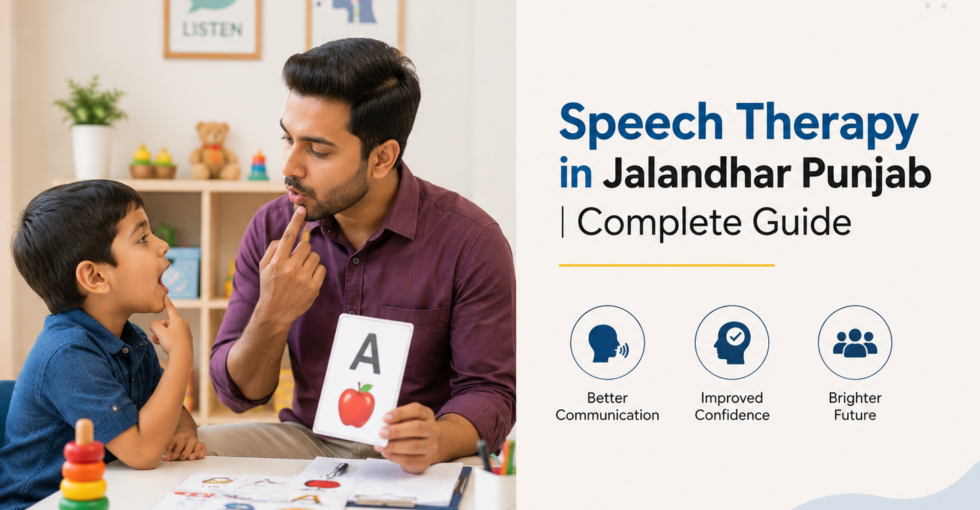

When your toddler isn’t talking at the age when other kids are blabbering non-stop, or when your school-going child struggles to pronounce basic sounds clearly, panic sets in fast. You end up scrolling endlessly on your phone, comparing your child to every kid on Instagram and wondering if they’re just a “late talker” or if something deeper is going on.
If you’ve been searching for reliable speech therapy Jalandhar Punjab services, take a breath. Language delays, speech sound errors, and stammering are far more common than most people realize and with the right intervention, kids adapt and overcome these barriers faster than you think.
This guide will help you understand when speech therapy is needed, what happens during sessions, how to choose the right therapist, and how parents can support their child’s communication journey.
Early Signs Your Child Might Need a Speech Therapist
Parents often get told by older relatives to “just wait until they turn three.” While every child moves at their own pace, waiting too long can mean missing the most crucial neurological window for language learning.
Here are the key signs to watch for based on age:
- 12 to 18 Months: Not responding to their name, minimal eye contact, no gestures (like waving or pointing), or zero babbling sounds.
- 2 to 3 Years: Uses fewer than 50 individual words, doesn’t combine two words together (e.g., “want milk”), or relies almost entirely on grunting and pointing to communicate.
- 3 to 5 Years: Speech is difficult for family members or outside relatives to understand, struggles to follow simple two-step instructions, or stutters frequently when trying to express a thought.
Quick Fact: A child’s brain forms over 1 million new neural connections every single second during the first few years of life. Addressing a speech delay early turns what could be a long-term struggle into a manageable, short-term milestone.
How Modern Speech Therapy Actually Works
Forget the old-school idea of sitting a toddler at a desk and drilling flashcards for an hour. Today’s generation of speech intervention is entirely play-based, interactive, and structured around your child’s natural interests.
Speech therapy helps children improve their ability to communicate effectively.
It focuses not only on speaking words but also on understanding language, expressing thoughts, interacting socially, and communicating confidently in everyday life.
Speech-language therapists assess each child’s communication skills and create personalized therapy plans based on individual developmental needs.
Therapy may help children improve:
- Speech clarity
- Language understanding
- Vocabulary
- Sentence formation
- Listening skills
- Social communication
- Feeding and oral motor skills in some cases
Every therapy plan is different because every child learns differently.
Whether a child is dealing with an articulation issue (trouble forming “R” or “S” sounds), expressive speech delays, or speech challenges linked to autism, therapy focuses on:
- Oral-Motor Strengthening: Building the jaw, lip, and tongue muscle control needed for clear pronunciation.
- Expressive & Receptive Language: Helping kids not just speak words, but actually process and understand what others say to them.
- Social Communication (Pragmatics): Teaching turn-taking, eye contact, and how to use language to build friendships at school.
Unsure if your child needs therapy or just a nudge?
Connect directly with qualified pediatric specialists for clear, honest guidance.
Call the Expert Helpline: +91 9800 990 088
When Should Parents Consider Speech Therapy?
Many parents ask, “Should we wait a little longer?”
Sometimes children naturally catch up.
Sometimes early support makes a significant difference.
You should consider an assessment if your child:
- Speaks very few words compared to children of the same age.
- Has difficulty understanding simple instructions.
- Finds it hard to express needs or feelings.
- Uses gestures more than words beyond the expected developmental stage.
- Has unclear speech that family members struggle to understand.
- Stammers frequently.
- Shows speech delays along with autism or developmental concerns.
Early assessment provides clarity.
It does not automatically mean something is wrong.
Why Parent Involvement Makes a Big Difference
Speech therapy doesn’t stop when the session ends. Children spend far more time at home than they do with therapists.
Simple activities like talking during meals, reading books together, asking open-ended questions, and encouraging conversation throughout the day reinforce communication skills naturally.
Even 15–20 minutes of daily interaction can help children practice what they learn during therapy.
Common Speech and Language Challenges in Children
Not every speech delay has the same cause. Understanding the difference helps families choose appropriate support.
- Speech Delay – Children understand language but use fewer words than expected for their age.
- Language Delay – Children may struggle to understand language, form sentences, or communicate ideas clearly.
- Speech Sound Disorders – Some children know exactly what they want to say but cannot pronounce certain sounds correctly.
- Stammering – Children may repeat sounds, pause frequently, or experience interruptions while speaking.
- Communication Challenges Associated with Autism – Many children with autism benefit from speech therapy because it supports expressive language, receptive language, social communication, and everyday interaction.
Speech therapy often works alongside Special Education Therapy, occupational therapy, and behavioural intervention for a comprehensive developmental approach.
How Long Does Speech Therapy Usually Take?
One of the most common questions parents ask is: “How long will my child need therapy?”
There is no fixed answer.
Every child’s progress depends on factors such as:
- Age
- Type of speech or language difficulty
- Developmental diagnosis
- Consistency of therapy
- Parent involvement
- Home practice
Some children make noticeable progress within months. Others require longer-term support.
The focus should always be on meaningful progress rather than comparing timelines with other children.
Bright Horizon: Expert Child Development Across Punjab
Finding a trusted speech therapy center in Jalandhar parents can rely on shouldn’t feel like a guessing game. Bright Horizon Child Development Center (a unit of Apricus Health Care India Pvt Ltd) operates as a leading developmental hub, delivering evidence-based therapy programs across Punjab.
Serving children aged 2 to 15 years, Bright Horizon removes the stress of fragmented care by providing complete, multidisciplinary support under one roof:
- Multi-Discipline Care: Expert-led child speech therapy Jalandhar integrated with ABA therapy, occupational therapy, sensory integration, behavioral modification, and Special Education Therapy.
- RCI-Certified Specialists: Therapy is delivered by certified, highly experienced speech-language pathologists and pediatric experts who focus on long-term results.
- Digital Therapy Records: Say goodbye to vague updates. Parents get access to digital tracking charts that clearly display weekly milestone improvements and session data.
- Wider Regional Reach: Beyond being a dedicated Jalandhar speech therapy center, Bright Horizon provides gold-standard clinical intervention for families searching for specialized Speech Therapy in Ludhiana and Speech Therapy in Hoshiarpur.
Why a Multidisciplinary Approach Often Works Better
Some children who need speech therapy also benefit from additional developmental support.
For example:
A child with autism may also require occupational therapy, ABA therapy, or Special Education Therapy.
Instead of visiting multiple clinics separately, multidisciplinary child development centers allow specialists to work together.
This coordinated approach helps children make progress across communication, behaviour, learning, and daily living skills.
Don’t Let Speech Delays Hold Your Child Back
Early intervention gives your child the confidence to speak up, make friends, and excel at school.
Consult with a Speech Therapist Jalandhar Expert Today: Call +91 9800 990 088 to book an initial assessment session.
Common Myths About Speech Therapy
Many parents delay therapy because of common misconceptions.
Myth 1 – “Boys always speak late.”
Truth – While development varies, significant speech delays should still be assessed by a professional.
Myth 2 – “My child will start talking naturally.”
Truth – Some children do, but waiting too long may delay important intervention opportunities.
Myth 3 – “Speech therapy is only about speaking.”
Truth – Speech therapy also supports language understanding, social communication, confidence, listening skills, and everyday interaction.
Myth 4 – “Only children with autism need speech therapy.”
Truth – Children with speech delays, language disorders, stammering, hearing difficulties, and articulation challenges may also benefit.
Ready to Help Your Child Find Their Voice?
Every child deserves the opportunity to express ideas, build friendships, participate confidently in school, and communicate with the people they love.
Early assessment, personalized therapy, family involvement, and consistent practice can make a meaningful difference over time. If you have concerns about your child’s speech or language development, don’t wait for uncertainty to become anxiety.
A professional developmental assessment can help you understand your child’s strengths and the best path forward.
Contact Bright Horizon Child Development Center today to schedule a consultation with our experienced child development specialists.
Call: +91 9800 990 088
Frequently Asked Questions
- How long does a child usually stay in speech therapy?
The timeline depends heavily on the root cause. Minor sound articulation issues can often be resolved in 3 to 6 months with consistent sessions. Deeper language delays or communication challenges associated with autism usually require a phased, long-term approach lasting 6 to 12+ months.
- Can screen time cause speech delays in young kids?
Excessive passive screen time (like endless short videos) reduces real-life human interaction, which is how a child’s brain learns language. While screens don’t directly “cause” brain damage, replacing face-to-face communication with screen time is one of the leading contributors to speech delays in today’s young children.
- What is the difference between a speech delay and a language delay?
A speech delay means the child is trying to talk, but the sounds or words are hard to understand (an issue with output and pronunciation). A language delay means the child struggles to understand instructions (receptive) or build complete thoughts and sentences (expressive).
- What happens during a speech therapy session?
Sessions usually include play-based activities, conversation practice, storytelling, language exercises, games, and communication-building activities tailored to the child’s needs.
- Can parents help improve speech at home?
Absolutely. Reading together, talking during everyday routines, encouraging conversation, and following therapist recommendations can reinforce communication skills.
- Is speech therapy only for children who cannot speak?
No. It also helps children with unclear speech, language delays, social communication difficulties, stammering, and communication challenges related to developmental conditions.
- Can speech therapy improve school performance?
Better communication often supports classroom participation, learning, confidence, and social interaction, which can positively influence school readiness and academic development.