
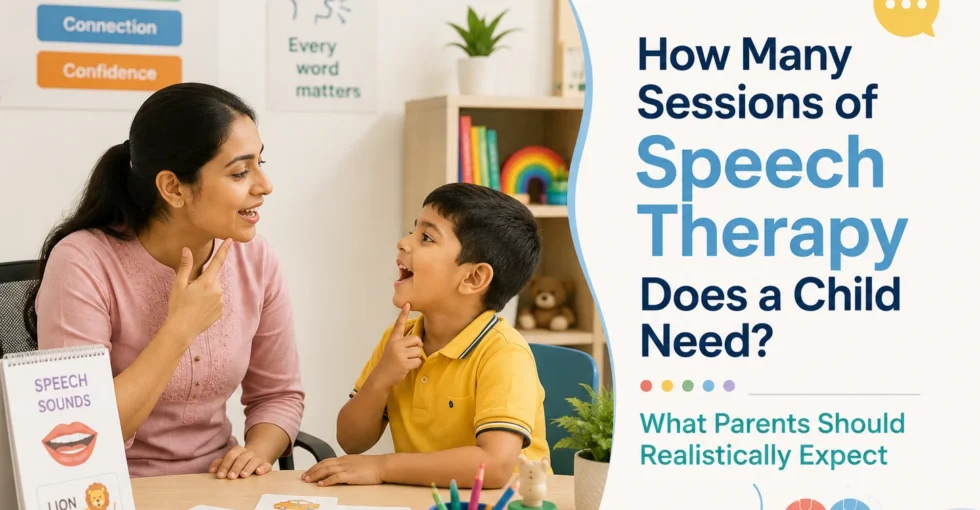

When your child is struggling to communicate, it’s completely normal to want immediate answers. You might find yourself constantly counting the days, waiting for that first clear sentence, and asking yourself the ultimate question: How long does speech therapy take for a child?
Parents want to know when their child will start talking more clearly, communicate confidently, and catch up with other children of the same age.
The truth is that there isn’t a fixed number of sessions that works for every child. Some children show noticeable improvements within a few months. Others need longer-term support because their communication challenges are more complex.
Understanding those factors helps parents set realistic expectations and stay motivated throughout the therapy journey.
Is There a Fixed Number of Speech Therapy Sessions?
The short answer is no.
Speech therapy is not like taking medicine for seven days. Every child’s brain, learning style, developmental history, and communication challenges are different.
A speech therapist first evaluates:
- Your child’s age
- Type of speech or language difficulty
- Overall developmental milestones
- Attention span
- Ability to understand language
- Family involvement
- Presence of conditions such as autism or hearing difficulties
Based on this assessment, an individualized therapy plan is created. That means two children of the same age may need very different therapy schedules.
What Decides How Long Speech Therapy Takes?
Several important factors influence the overall duration of therapy.
The Type of Speech Difficulty
Not all communication challenges are the same.
A child who has difficulty pronouncing a few sounds may progress faster than a child with broader language delays or autism-related communication challenges.
For example:
- Speech sound disorders often require focused articulation practice.
- Language delays may involve building vocabulary, understanding, and sentence formation.
- Children with autism may need support with both communication and social interaction.
Because every diagnosis is different, the therapy journey also differs.
Your Child’s Age
Young children’s brains are remarkably adaptable. Early intervention often allows therapists to strengthen communication skills during a period of rapid brain development.
This doesn’t mean older children cannot improve. They absolutely can.
However, children who begin therapy earlier often have more opportunities to build foundational communication skills before starting school.
How Consistently Therapy Is Followed
One therapy session each week is only part of the process. The real progress often happens between sessions.
Children who regularly practice therapist-recommended activities at home tend to reinforce new skills more effectively.
Even 15–20 minutes of daily language-rich interaction can make a meaningful difference over time.
Wondering What Therapy Plan Is Right for Your Child?
Every child deserves a personalized assessment rather than a one-size-fits-all answer.
Speak with our speech therapy experts today: +91 9800990088.
How Many Speech Therapy Sessions Per Week Are Usually Recommended?
Many parents search for speech therapy sessions per week in India hoping for a simple answer. The reality is that session frequency depends on the child’s needs.
Some children may benefit from:
- One session per week for mild speech concerns.
- Two to three sessions weekly for mild communication delays.
- More intensive therapy when recommended by the speech-language pathologist, especially for children with complex developmental needs.
The decision is based on assessment findings, therapy goals, and how well the child is progressing.
The focus should always be on quality and consistency not just the number of sessions.
Setting a Realistic Speech Therapy Results Timeline
Progress doesn’t happen like a light switch turning on; it’s a steady staircase. Based on general clinical milestones, here is a transparent breakdown of what real progress looks like over time:
Weeks 1 to 6: The Foundation
At this stage, do not expect perfect sentences. The focus here is on behavioural readiness and connection. You will notice your child building a better attention span, making steadier eye contact, and responding more consistently to their name or simple direct instructions.
Months 3 to 6: The Breakthroughs
This is typically the window where tangible communication shifts show up. Children often begin imitating sounds more frequently, trying out new single words, and dropping common speech sound errors. They also become much better at expressing basic needs (like hunger or wanting a specific toy) without throwing tantrums.
Months 6 to 12+: Long-Term Consolidation
For moderate to complex delays, this is where language begins to grow in true layers. Skills stabilize, vocabulary expands into phrases, and speech becomes noticeably clearer to unfamiliar relatives and outsiders.
What If My Child Isn’t Improving Quickly?
Every parent hopes for rapid progress. Sometimes improvements happen faster than expected. Sometimes they take longer.
That does not automatically mean therapy isn’t working.
Children may require more time if they have:
- Autism Spectrum Disorder
- Developmental delays
- Hearing difficulties
- Attention challenges
- Multiple communication needs
A good therapist regularly reviews goals, adjusts activities, and monitors progress rather than simply repeating the same exercises.
Progress Isn’t Always Measured by Words Alone
Sometimes the biggest improvements happen before a child starts speaking more.
A child who begins pointing to objects, making eye contact, taking turns during play, or responding to simple questions is building the communication skills needed for future language development.
These milestones are just as important as spoken words. Open communication between therapists and parents is essential throughout the process.
Speech Therapy in Jalandhar and Ludhiana: Finding the Right Support
If you are looking for dedicated developmental care in Punjab, Bright Horizon Child Development Center (a unit of Apricus Health Care India Pvt Ltd) provides comprehensive, multidisciplinary intervention.
Serving families looking for trusted Speech Therapy in Jalandhar and specialized Speech Therapy in Ludhiana, the center supports children aged 2 to 15 years. Bright Horizon integrates expert certified therapists with highly personalized treatment plans, digital therapy records, and completely transparent, goal-based sessions. Beyond speech intervention, their holistic approach covers autism therapy, occupational therapy, ABA therapy, sensory integration, behavioral modification, and special education.
How Do Therapists Measure Progress?
Progress is much more than counting how many words a child speaks.
Speech-language therapists often evaluate:
- Vocabulary growth
- Sentence formation
- Speech clarity
- Listening skills
- Social communication
- Confidence while speaking
- Ability to communicate needs independently
This is why structured progress reviews are so valuable. Parents should clearly understand what goals have been achieved and what comes next.
Every Child Progresses at Their Own Pace
Comparing your child’s journey with another child’s can create unnecessary anxiety. What matters most is whether your child is making steady progress toward their own developmental goals.
If you have concerns about your child’s communication, the best first step is a professional assessment—not guessing based on internet timelines.
Schedule a consultation with our speech therapy experts today: +91 9800990088.
Frequently Asked Questions
- Why is my child not speaking clearly even after 2 months of therapy?
The first few weeks of therapy are dedicated to building rapport, active listening, and compliance. Language builds in structural layers. If your child is making better eye contact, showing less frustration, or using gestures more intentionally, the therapy is actively working.
- How many sessions per week are mandatory for an early speech delay?
For children who need intensive intervention, 5–6 therapy sessions per week, along with 15–20 minutes of guided home practice each day, can help accelerate speech and language development. The exact schedule is personalized based on your child’s age, goals, and therapist’s assessment.
- When will I start seeing results from speech therapy?
Many families notice gradual improvements in communication, attention, and interaction before significant speech changes occur. Progress differs for every child.
- Can speech delay be completely treated?
Many children improve significantly with early intervention, consistent therapy, and family involvement. Outcomes depend on the underlying cause of the delay.
- What if my child misses therapy sessions?
Occasional missed sessions are understandable, but regular attendance and consistent home practice generally support better progress.
- Can parents help improve speech at home?
Yes. Reading together, talking during daily routines, interactive play, and following therapist recommendations are excellent ways to reinforce communication skills.