
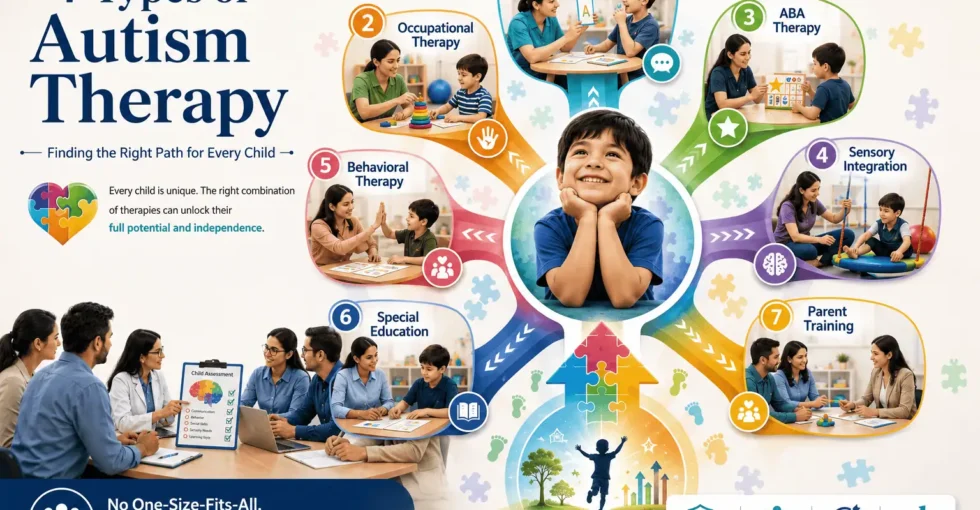

When a parent first learns their child is on the autism spectrum, they are instantly handed a massive list of acronyms: ABA, OT, SLP, CBT, PRT. If you’re a parent navigating this in Punjab, you don’t need academic jargon or empty promises of a “miracle cure.”
You need to know what actually works.
Parents quickly find themselves asking:
“Which therapy does my child actually need?”
“Are all therapies necessary?”
“What is the best therapy for an autistic child?”
The truth is, there isn’t one universal therapy that works for every child. Autism is a spectrum. Every child has different strengths, challenges, learning styles, and developmental goals.
That’s why understanding the different types of autism therapy in India is one of the most important steps parents can take after diagnosis.
Let’s break it down in a simple and practical way.
The 7 Core Types of Autism Therapy Available in India
Imagine taking a child who struggles with communication and enrolling them only in handwriting sessions. Or focusing entirely on speech while ignoring severe sensory challenges.
Progress may happen, but it won’t be as effective. The most successful autism intervention plans target the child’s specific developmental needs rather than following a one-size-fits-all approach.
A therapy that works exceptionally well for one child may not be the most important starting point for another.
The goal isn’t to find the “best” therapy. The goal is to find the right combination of therapies for your child.
An effective clinical strategy relies on a multi-disciplinary network. Because autism impacts communication, sensory processing, and motor planning differently in every child, your care team should draw from these 7 essential disciplines:
1. Applied Behaviour Analysis (ABA Therapy)
ABA Therapy is one of the most widely recognized autism intervention approaches worldwide.
The focus is on helping children learn new skills while reducing behaviours that interfere with learning and participation.
ABA programs often work on:
- Communication
- Social skills
- Attention
- Learning readiness
- Adaptive behaviour
- Daily routines
Modern ABA programs are highly individualized and goal-oriented.
The emphasis is on helping children function more independently in everyday situations.
2. Speech and Language Therapy
This is usually the therapy parents recognise first, because communication difficulty is often the most visible early sign of autism. A speech-language pathologist works on everything from basic word formation to the much broader skill of functional communication being understood, expressing needs, and using language socially, not just correctly.
Speech therapy focuses on helping children communicate their needs, thoughts, emotions, and ideas more effectively.
Some children learn to use spoken language. Others may benefit from visual communication systems or alternative communication methods.
The ultimate goal is functional communication. Because communication impacts almost every area of life.
Speech therapy is rarely a standalone solution for autism specifically, but it’s almost always part of the plan, because communication challenges sit at the centre of so much else behaviour, social participation, even classroom learning.
3. Occupational Therapy (OT)
Many parents are surprised to learn how much occupational therapy contributes to daily life. Occupational therapy addresses the physical and sensory side of daily functioning fine motor skills like handwriting and using utensils, sensory processing, and independence in tasks like dressing, eating, and grooming.
For many autistic children, occupational therapy becomes a bridge between therapy goals and real-world success. A meltdown in a crowded classroom, refusal to wear certain clothes, or constant fidgeting often trace back to a sensory regulation issue an occupational therapist is specifically trained to identify and address not a discipline problem, which is unfortunately how it’s sometimes misread by teachers or relatives unfamiliar with autism.
OT also increasingly factors in the world today’s kids actually live in. Grip strength and hand coordination affect a child’s ability to use a tablet, hold a game controller properly, or type, not just hold a pencil. A therapist working with a Gen Alpha child who’s far more motivated by a touchscreen than a worksheet will often use that motivation deliberately, building real fine motor skills through tools the child already wants to use.
4. Sensory Integration Therapy
Sensory integration is sometimes treated as part of OT, but it’s substantial enough to stand on its own. It specifically targets how a child’s brain processes and organises sensory input touch, sound, movement, balance through structured activities designed to help the nervous system respond more typically over time.
Many autistic children experience the world differently through their senses.
- Certain sounds may feel overwhelming.
- Specific textures may be uncomfortable.
- Crowded environments can become difficult to manage.
Sensory Integration Therapy helps children process sensory information more effectively.
The goal is not to eliminate sensory differences. The goal is to help children participate more comfortably in daily life.
A systematic review and meta-analysis on sensory integration therapy found it effectively improved social skills, adaptive behaviour, and both fine and gross motor coordination in children with autism, with individual one-on-one sessions of around 40 minutes showing the strongest results.
For children who are either overwhelmed by sensory input or constantly seeking it out spinning, crashing into things, chewing on objects, this therapy often becomes the foundation that makes everything else (learning, communication, behaviour) more accessible, simply because a regulated nervous system has more capacity to engage.
5. Special Education Therapy
Many parents assume special education begins only after school admission.
In reality, Special Education Therapy can play a crucial role in preparing children for learning environments. Special education focuses specifically on academic learning, adapting teaching pace, method, and material to match how an individual child learns best, rather than expecting the child to keep pace with a standard classroom curriculum.
In India, this has real legal backing that many parents don’t know about. The Rights of Persons with Disabilities Act, 2016 mandates free education for children with disabilities, including autism, between ages 6 and 18, and gives children the right to individualised education plans and reasonable accommodations within mainstream schools, not just separate special schools. A disability certificate, obtainable through government medical boards, unlocks access to these protections along with other government benefits and accommodations, including extended exam time and accessible learning material.
Special education and clinical therapy work best together rather than separately with a child making strong gains in speech and OT still needs an academic environment structured to actually let those gains translate into classroom learning.
6. Behavioural Modification Therapy
Behavioural challenges are often a form of communication. A child may not have the words to express frustration, discomfort, anxiety, or confusion.
Behavioural modification programs help children develop healthier ways of responding to situations. For older children and teenagers on the spectrum, anxiety and emotional regulation can become highly complex challenges. This therapy acts as a practical talk-and-action framework. It gives verbal children concrete, logical tools to recognize their own internal stress signals, process anxiety, and de-escalate their own panic responses before they spiral out of control.
Therapists work on:
- Emotional regulation
- Following routines
- Social behaviour
- Coping strategies
- Positive reinforcement techniques
This support often benefits both children and families.
7. Autism-Specific Early Intervention Programs
Many centres now offer integrated autism intervention programs that combine multiple therapies under one structured plan.
These programs often include:
- Speech Therapy
- Occupational Therapy
- ABA Therapy
- Sensory Integration
- Behavioural Intervention
- Special Education Support
This multidisciplinary approach ensures that different developmental needs are addressed simultaneously.
For many families, integrated intervention creates a more coordinated path toward progress.
So, Which Therapy Is Best for an Autistic Child?
This is probably the most searched question among parents. And the answer may surprise you.
There is no single “best therapy for autistic child.”
The best therapy depends on:
- Age
- Developmental level
- Communication skills
- Sensory needs
- Behavioural challenges
- Learning abilities
- Family goals
For example:
A child with delayed speech may require intensive speech therapy. A child struggling with sensory overload may benefit significantly from occupational therapy and sensory integration.
Another child may require a combination of therapies. The focus should always remain on the child’s individual needs rather than popular therapy trends.
Common Mistakes Parents Make While Choosing Autism Treatment Options
One common mistake is choosing therapy based solely on recommendations from friends or social media. Every child’s profile is unique.
Another mistake is switching therapies too frequently before progress can be properly evaluated.
Parents should also be cautious about programs that promise unrealistic outcomes. Effective intervention focuses on meaningful progress, not miracle claims.
Feeling Overwhelmed by Different Therapy Recommendations?
You’re not alone.
Many families need guidance to understand which therapies match their child’s developmental needs.
Call our experts: tel:+919800990088
Autism Treatment in Ludhiana and Across Punjab: How Bright Horizon Child Development Center Supports Families
If you’re comparing an autism centre in Ludhiana or weighing autism center Jalandhar treatments, a few things matter more than glossy marketing.
Certified, autism-specific therapists across multiple disciplines, not a single generalist offering everything genuinely changes the quality of care a child receives. Coordinated treatment planning, where speech, OT, and behavioural strategies are aligned under one shared plan rather than run by three separate providers who never communicate, produces noticeably better outcomes than fragmented care.
Transparent progress tracking lets you see exactly what’s being targeted and why, instead of vague verbal reassurance. And genuine parent training and involvement should be built into the program from day one, not offered as an afterthought.
At Bright Horizon Child Development Center, a unit of Apricus Health Care India Pvt Ltd, we bring autism therapy, speech therapy, occupational therapy, ABA therapy, sensory integration, behavioural modification, and special education together under one coordinated, personalised plan for children aged 2 to 15 across Punjab. Every child starts with an individual assessment rather than a generic package, and we maintain digital therapy records so parents can track real, goal-based progress over time.
Instead of offering generic programs, we create personalized intervention plans based on developmental assessments and measurable goals.
Families benefit from:
- Expert certified therapists
- Goal-based therapy sessions
- Digital therapy records
- Transparent progress tracking
- Family involvement and guidance
- Customized treatment plans
How Modern Autism Therapy Has Changed
A decade ago, therapy often focused only on reducing challenges. Today, the focus has shifted.
Modern intervention programs emphasize:
- Strength-based development
- Communication
- Independence
- Functional life skills
- Inclusion
- Quality of life
Today’s generation of parents wants more than therapy reports. They want their children to build real-world skills that help them thrive at home, school, and in society.
That shift has transformed autism intervention for the better.
Secure Your Child’s Personalized Care
Choosing among the many types of autism therapy in India can feel overwhelming at first.
But remember this: The goal isn’t to find the most popular therapy. The goal is to understand your child’s unique needs and build a support plan around them.
For some children, communication may be the priority. For others, sensory regulation, learning readiness, behaviour, or daily living skills may require attention first.
The right therapy plan is rarely about choosing one option. It is about creating the right combination. And when that combination is guided by experienced professionals, meaningful progress often follows.
Protect your child’s vital early childhood developmental window by scheduling an extensive clinical consultation with our certified multi-disciplinary panel.
Connect with Bright Horizon: Call us directly at +91 9800990088 to map your individualized treatment pathway.