
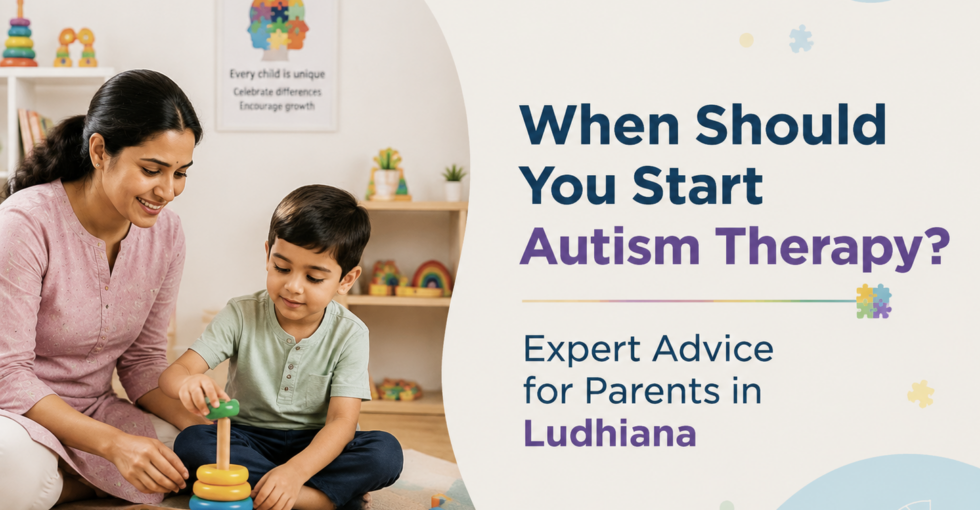

When you notice that your toddler isn’t making eye contact, isn’t responding to their name, or seems completely overwhelmed by noisy rooms, the urge to “wait and see” can be strong. Older relatives might tell you, “He’s just a late bloomer,” or “She’ll start talking when school begins.”
However, clinical research and pediatric neurology give us a very clear answer: The best time to start autism therapy is the exact moment you notice developmental differences. You do not need to wait for a formal, rigid diagnosis to begin building your child’s communication and sensory skills.
If you are looking into Autism Therapy for kids in Punjab, understanding the power of early intervention will help you make confident decisions for your family.
Why Timing Matters in Autism Therapy
A child’s brain develops rapidly during the first few years of life.
During this period, children are learning language, social interaction, emotional regulation, play skills, and daily routines. When developmental support begins early, children have more opportunities to build these important life skills.
Early therapy isn’t about rushing childhood. It’s about giving children the right support when their brains are developing rapidly.
Even if your child is older, therapy can still make a meaningful difference. The important step is not waiting unnecessarily.
What Are the Early Signs Parents Shouldn’t Ignore?
Many children develop at different speeds. However, some behaviours deserve a professional developmental assessment.
You may want to consult a specialist if your child:
- Rarely responds to their name
- Has limited eye contact
- Uses very few words or no words
- Repeat the same activities over and over
- Struggles to interact with other children
- Becomes extremely upset by changes in routine
- Shows unusual reactions to sounds, lights, or textures
- Has difficulty expressing needs
These signs don’t automatically confirm autism. They simply indicate that your child may benefit from a professional developmental evaluation.
The Science of Neuroplasticity: Why Ages 2 to 5 Matter Most
In the first few years of life, a child’s brain forms over 1 million new neural connections every single second. This phenomenon known as brain neuroplasticity, means a toddler’s brain is naturally wired to adapt, build new communication pathways, and learn faster than at any other stage of human development.
When treatment for autism in Ludhiana starts early, the results are compound:
- Faster Language Acquisition: Children learn functional communication (words, gestures, or visual cards) before frustration leads to intense tantrums.
- Sensory System Regulation: Early occupational therapy helps balance hyper-sensitive nervous systems before school environments trigger severe overload.
- School Readiness: Up to 40% of children receiving early, intensive developmental support transition smoothly into mainstream kindergarten settings.
Parent Reality Check: Waiting 6 to 12 months to “see if things improve” often means missing the most flexible learning window your child’s brain will ever have. Early support isn’t a label, it’s a boost.
Why Early Autism Therapy Makes a Difference
Parents often worry that therapy means something is “wrong” with their child. In reality, therapy is designed to help children build practical skills for everyday life.
Early intervention may support improvements in:
- Communication
- Social interaction
- Emotional regulation
- Attention
- Daily living skills
- Learning readiness
- Independence
Research consistently shows that early developmental support can improve long-term outcomes for many children with autism.
Every child is unique, so progress happens at different rates.
Which Therapy is Best for Autism?
Parents often feel lost in the alphabet soup of therapies: ABA, OT, ST, SI, and Special Ed. The truth is, there isn’t a single “best” therapy, autism is a multi-system condition, so a multi-system approach yields the highest success rates.
| Therapy Type | What It Targets | Primary Goal |
| ABA Therapy for Autism Kids | Behavioral patterns, compliance, and social prompts | Replaces frustration-driven meltdowns with positive, functional communication. |
| Occupational Therapy & Sensory Integration | Fine motor skills, physical balance, and environmental triggers | Calms fight-or-flight responses caused by sound, light, or tactile sensitivities. |
| Pediatric Speech Therapy | Speech clarity, vocal output, and receptive understanding | Moves a child from non-verbal isolation to active verbal or gesture communication. |
| Special Education Therapy | Academic comprehension and cognitive readiness | Adapts learning materials so neurodivergent kids can process school tasks effortlessly. |
What Does a Realistic Autism Therapy Results Timeline Look Like?
Therapy doesn’t transform a child overnight, but tracking autism treatment progress signs gives parents concrete milestones to celebrate:
- Months 1 to 3 (The Baseline Phase): Improved eye contact, fewer severe sensory meltdowns, and better response to their name.
- Months 3 to 6 (Communication Spurt): Early attempts at functional pointing, single words, or picture communication cards to ask for water or snacks.
- Months 6 to 12+ (Social & Emotional Integration): Ability to self-regulate during routine changes, parallel play alongside peers, and readiness for structured group environments.
Book a Diagnostic & Behavioral Assessment
Give your child access to structured, science-backed care in a warm, welcoming space.
Consult with Ludhiana Experts: Call +91 9800990088 to reserve a consultation slot.
What Happens During the First Autism Therapy Assessment?
Many parents feel nervous before their first appointment. A developmental assessment is not an examination your child has to “pass.”
Instead, therapists observe how your child:
- Communicates
- Plays
- Learns
- Responds to instructions
- Interacts socially
- Processes sensory information
- Performs everyday activities
Based on these observations, therapists create individualized therapy goals instead of using the same treatment plan for every child.
What Does an Autism Therapy Results Timeline Look Like?
Parents naturally want to know when they’ll see improvement. The truth is that there is no fixed autism therapy results timeline.
Every child progresses differently. Some children show encouraging changes within weeks. Others need several months before noticeable improvements become visible.
Progress often begins with small milestones such as:
- Better eye contact
- Increased attention
- Improved response to name
- More communication attempts
- Better participation during play
- Greater independence in routines
Small improvements eventually build into larger developmental achievements.
Bright Horizon: Premier Autism Treatment in Ludhiana & Across Punjab
Finding trusted, high-quality Autism Treatment in Ludhiana should not require traveling between different clinics scattered across town. Bright Horizon Child Development Center (a unit of Apricus Health Care India Pvt Ltd) brings every essential therapy under one multidisciplinary roof.
Recognized as a leading Autism Centre in Ludhiana and widely trusted for providing the best autism treatment in punjab, Bright Horizon supports children aged 2 to 15 years with complete clinical clarity:
- RCI-Certified Therapists: Your child works directly with accredited behavioral analysts, occupational therapists, and speech pathologists.
- Personalized Treatment Plans: No generic routines—therapy is tailored around your child’s specific sensory profile and hyper-fixations/interests.
- Digital Therapy Records: View real-time behavioral charts, milestone reports, and video progress right from your smartphone.
- Transparent Goal-Based Sessions: Every 12 weeks, clinical goals are audited to ensure your child is consistently moving forward.
What Parents Can Do While Waiting for Therapy
The period before therapy begins is also valuable.
Parents can support development by:
- Talking to their child during daily routines.
- Reading picture books together.
- Encouraging turn-taking games.
- Creating predictable routines.
- Celebrating small communication attempts.
- Reducing unnecessary screen time in favor of interactive play.
These everyday moments strengthen learning and complement professional therapy.
Take The First Confident Step Toward Your Child’s Development
A professional developmental assessment can answer your questions, identify your child’s strengths, and guide the next steps with confidence.
Every child deserves the opportunity to communicate, learn, build relationships, and participate confidently in everyday life.
And every meaningful journey begins with a single step. If you have concerns about your child’s development, don’t wait for uncertainty to become a worry.
Contact Bright Horizon Child Development Center today to schedule a consultation with our experienced child development specialists.
Call: +91 9800 990 088
Frequently Asked Questions
- Is age 2 too early to start ABA therapy for autism kids?
No. Age 2 is considered an optimal window. Early ABA therapy for toddlers looks nothing like adult-led instruction, it is 100% play-based, naturalistic, and focused on joint attention, babbling, and basic motor skills.
- What if my child is older (ages 7 to 12)? Is it too late to start therapy?
It is never too late. While early intervention takes advantage of peak brain flexibility, older children still make significant gains in emotional regulation, social interaction, executive function, and independence.
- How do I know if my child is making genuine progress in therapy?
Look for objective, data-driven progress charts rather than general promises. Real signs include reduced communication tantrums, increased spontaneous gestures or words, and an improved ability to adapt when daily routines change.
- Can parents support autism therapy at home?
Yes. Following therapist guidance, maintaining routines, reading together, encouraging communication, and participating in interactive play all reinforce developmental learning.
- How often should my child attend autism therapy?
The frequency depends on your child’s assessment, therapy goals, and recommendations from the multidisciplinary team.
- Why is early intervention important?
Young children’s brains develop rapidly, making early support especially valuable for building communication, learning, social, and daily living skills.
- What are the first signs that autism therapy is working?
Early improvements may include better eye contact, increased communication attempts, improved attention, greater participation in activities, and reduced frustration.