
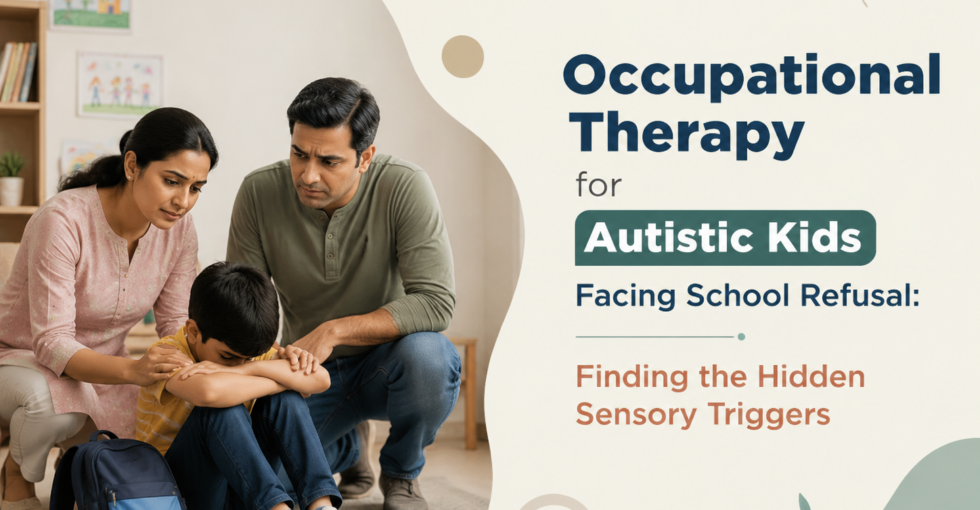

Every morning starts the same way.
Your child refuses to wear the school uniform.
They cry as soon as they see the school bag.
They become anxious, angry, or completely silent before leaving home.
As a parent, it’s heartbreaking.
You may wonder:
“Is my child just being stubborn?”
“Do they dislike school?”
“Why is every school morning becoming a battle?”
For many autistic children, school refusal isn’t about avoiding studies.
It’s often their way of saying, “Something in this environment feels overwhelming, but I don’t know how to explain it.”
This is where Occupational Therapy for Autistic Kids can make a meaningful difference. Instead of focusing only on behaviour, occupational therapists look deeper to understand the sensory, emotional, and environmental reasons behind school refusal.
When those hidden triggers are identified and managed, many children begin feeling safer, calmer, and more confident about going to school.
School Refusal Is Often a Sign, Not the Problem
Parents are sometimes advised to be stricter or more disciplined. But for autistic children, refusing school is often a response to genuine challenges.
A child may not be avoiding learning.
They may be trying to avoid discomfort.
That discomfort could come from:
- Loud classroom noise
- Bright lights
- Crowded hallways
- Scratchy school uniforms
- Unexpected schedule changes
- Difficulty understanding social situations
- Anxiety about communication
Children may not have the words to explain what they’re experiencing. Instead, their behaviour becomes their communication.
The Hidden Sensory Triggers Behind School Avoidance
Parents often ask, “Can occupational therapy help with autism and school refusal?” The short answer is yes, because pediatric occupational therapists (OTs) look at behavior through a sensory lens.
When an autistic child’s nervous system receives more sensory input than it can process, it enters a state of sensory overload. Here are the invisible triggers an OT digs for:
- Auditory Overload: The sudden, high-pitched screech of the school bell or the chaotic echo of a crowded cafeteria.
- Visual Fatigue: The subtle, 60Hz flickering of fluorescent classroom tubes that neurotypical brains filter out, but an autistic brain processes like a continuous strobe light.
- Tactile Sensitivity: Scratchy school uniform tags, stiff fabric, or the unexpected physical touch of peers in a crowded hallway line.
- Vestibular & Proprioceptive Dysregulation: The physical exhaustion of being forced to sit upright in a hard wooden chair for hours without the movement input their body craves to feel grounded.
Parent Reality Check: School refusal is rarely a “discipline issue.” It’s self-preservation. When a child’s brain senses an intolerable environment, refusal is the only tool they have left to keep themselves safe.
Struggling with morning school meltdowns?
Talk with a pediatric OT specialist to identify your child’s unique sensory profile.
Call the Developmental Helpline: +91 9800 990 088
Key Benefits of Occupational Therapy for Autistic Children
Understanding the distinct types of occupational therapy for autism helps parents move from feeling helpless to having a clear, actionable game plan.
A comprehensive parent’s guide to occupational therapy for autism focuses on three core pillars:
1. Sensory Integration (SI) Therapy
This targets how the brain receives, organizes, and responds to sensory input. OTs use specialized equipment—like suspended swings, weighted compression vests, and tactile crash pads—to help retrain the nervous system so everyday sensory inputs no longer register as immediate threats.
2. Custom “Sensory Diets”
An OT creates a tailored daily routine filled with micro-activities (like heavy-work joint compression, wall pushes, or weighted lap pads) designed to keep your child regulated throughout the school day.
3. Emotional Self-Regulation & Interoception
Kids are taught to recognize their body’s internal stress signals (like a racing heart or tight stomach) before a full meltdown happens, giving them sensory tools to regulate independently.
Practical Strategies: Occupational Therapy for Autism at Home
While clinical sessions are essential, the real magic happens when parents weave OT strategies into everyday routines:
- Build a Calming Morning Routine: Avoid rushing. Use visual schedules with simple picture icons to reduce executive function overload before leaving the house.
- Decompress the Uniform: Cut out all tags, wash school clothes with unfragranced detergent multiple times to soften the fibers, and swap stiff shoes for seamless, comfortable options.
- Create a Safe “Reset” Space: Set up a quiet corner at home with a pop-up tent, weighted blankets, and noise-canceling headphones so your child can reset after school without demands.
Signs Sensory Challenges May Be Affecting School
Every autistic child experiences sensory processing differently.
Some common signs include:
- Crying before school every day
- Covering ears in noisy places
- Refusing to wear certain clothes
- Difficulty sitting in the classroom
- Becoming exhausted after school
- Avoiding group activities
- Frequent meltdowns after returning home
- Difficulty transitioning between activities
These behaviours are often misunderstood. In reality, they may be signals that a child needs additional support.
Why School and Therapists Should Work Together
One challenge many families face is that therapy happens in one place while school happens somewhere else.
Children benefit most when everyone works as a team.
Occupational therapists may recommend simple classroom adjustments such as:
- Scheduled sensory breaks
- Flexible seating
- Visual schedules
- Noise-reducing headphones where appropriate
- Gradual transitions between activities
- Movement opportunities during long lessons
Small environmental changes can sometimes reduce stress significantly.
What Progress Should Parents Realistically Expect?
Parents naturally hope their child will suddenly enjoy going to school. Progress usually happens gradually.
Early improvements may include:
- Less anxiety before school
- Better morning routines
- Improved attention in class
- Greater participation during activities
- Fewer meltdowns after school
- Better communication about feelings
Each child develops differently. The goal is steady improvement rather than instant change.
Every Small Step Builds Long-Term Confidence
If school has become stressful for your child, don’t wait until anxiety becomes a daily struggle.
Early support can help identify sensory triggers and develop practical solutions.
Book a consultation today: +91 9800 990 088
Specialized Autism & OT Care Across Punjab
Finding an experienced occupational therapist for autistic child Punjab families trust shouldn’t involve endless clinic hopping. Bright Horizon Child Development Center (a unit of Apricus Health Care India Pvt Ltd) brings holistic, evidence-backed developmental interventions to your doorstep.
Serving children aged 2 to 15 years across Punjab, Bright Horizon replaces vague feedback with structured, transparent progress:
- Multidisciplinary Expertise: Specialized OT therapy autism Jalandhar programs seamlessly integrated with ABA therapy, speech-language pathology, sensory integration rooms, behavioral modification, and special education.
- Certified Clinical Teams: Sessions are conducted by RCI-registered and pediatric-certified OTs trained in modern sensory integration protocols.
- Objective Digital Records: Monitor your child’s sensory processing shifts, attention span improvements, and behavioral data using clean digital therapy tracking.
- Regional Accessibility: Offering top-tier clinical care for families searching for Occupational Therapy in Ludhiana and surrounding regions across Punjab.
Ready to Address the Root Causes of Your Child’s School Avoidance?
By identifying sensory triggers, building practical life skills, and helping children feel safe in their environments, Occupational Therapy for Autistic Kids can make school a place of learning rather than fear.
Every child deserves to feel understood—not judged.
If your child is struggling with school, daily routines, sensory challenges, or independence, an early developmental assessment can provide clarity and guide the next steps.
Contact Bright Horizon Child Development Center today to schedule a consultation with our experienced child development specialists.
Call: +91 9800 990 088
Frequently Asked Questions
- How long does it take for occupational therapy to help with school refusal?
While every child’s sensory profile is different, most parents begin noticing early benefits of occupational therapy for autistic children—such as reduced morning anxiety and better emotional regulation—within 6 to 12 weeks of consistent SI therapy and sensory diet implementation.
- Will an OT visit my child’s school to evaluate sensory triggers?
Yes. Many pediatric OTs collaborate directly with educators to assess classroom lighting, seating ergonomics, and noise levels, recommending reasonable accommodations like sensory breaks or quiet spaces.
- Can OT help if my child is non-verbal?
Absolutely. OT relies heavily on observing non-verbal cues, physiological stress responses, and physical behaviors. An OT doesn’t need a child to speak to pinpoint exactly which sensory systems are over-responding or under-responding.
- Why does my autistic child refuse to go to school?
School refusal may be linked to sensory overload, communication difficulties, anxiety, social challenges, changes in routine, or environmental stress rather than unwillingness to learn.
- What are sensory triggers?
Sensory triggers are sounds, lights, textures, smells, movements, or environments that feel overwhelming to a child because of differences in sensory processing.
- Can parents continue occupational therapy activities at home?
Yes. Therapists often recommend simple home routines and sensory strategies that reinforce learning between sessions.
- How do therapists know if occupational therapy is working?
Progress is measured through individualized goals, parent feedback, classroom participation, independence, sensory regulation, and improvements in daily activities.
- Does every autistic child need occupational therapy?
Not every child requires occupational therapy, but many benefit from an assessment if they experience sensory, motor, self-care, or school participation challenges.