
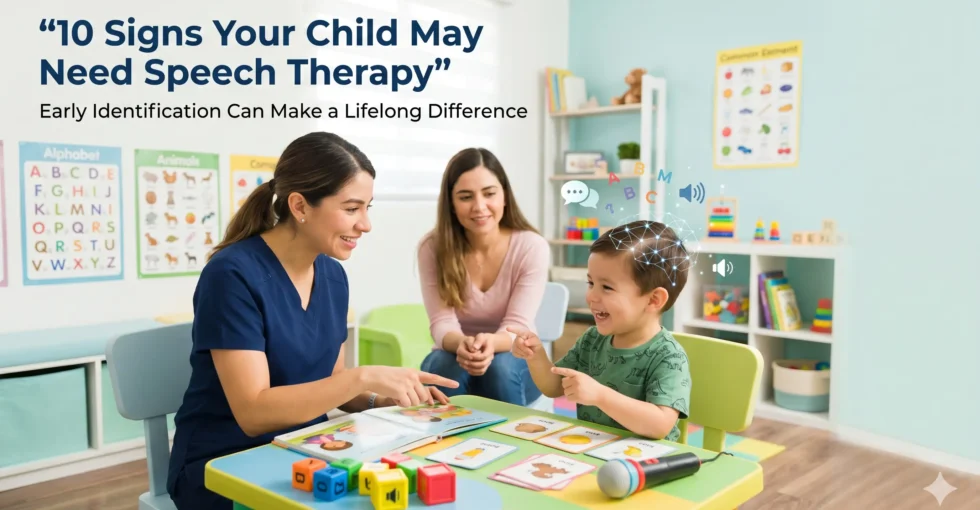

Have you ever found yourself wondering: “My child is 2 years old and still not talking properly. Should I be worried?”
Or perhaps you’ve searched online for a speech therapist near me after comparing your child’s communication skills with other children of the same age.
If yes, you’re not alone.
One of the most common concerns parents have during their child’s early years is speech and language development. While every child grows at their own pace, delayed communication can sometimes be a sign that professional support is needed.
The good news? Early intervention can make a remarkable difference.
Understanding what speech therapy actually is and how a targeted, multidisciplinary approach can fundamentally wire your child’s communication channels is the first step toward changing their developmental trajectory.
What Is Speech Therapy, Exactly?
Speech Therapy in Jalandhar provides structured, evidence-based treatment that helps children develop essential communication skills, including language comprehension, clear speech, sentence formation, and confident social interaction. Conducted by experienced speech-language pathologists (SLPs), therapy sessions combine play-based learning, repetition, and personalized exercises to support every child’s progress.
It’s worth pausing on two words people use interchangeably but shouldn’t: speech and language.
- Speech is the physical act of producing sounds – using your lips, tongue, jaw, and breath correctly to form words clearly.
- Language is the mental side – understanding words, building vocabulary, putting sentences together, and using the right words for the right context.
A child can have trouble with one and not the other. Some children understand everything said to them but struggle to physically produce clear words (a speech issue). Others can pronounce words fine but can’t string them into sentences or follow instructions (a language issue). A good speech therapist tells you, early on, which one – or both – your child is dealing with, because the treatment plan looks different either way.
“Parents often think their child ‘just needs to talk more.’ In reality, about a third of the children we evaluate have a language-processing gap, not a speech-production problem. Identifying which one you’re dealing with changes everything about the therapy plan.” – a common observation among pediatric SLPs in clinical practice.
Not sure which one applies to your child? Book a free initial consultation with our certified therapists at Bright Horizon Child Development Center.
The Science Behind Language Development
The first few years of life are considered one of the most important periods for brain development.
During these years, children’s brains create millions of neural connections that support learning and communication. This is why early intervention is so powerful.
The earlier communication challenges are identified, the more effectively therapists can support development during these critical learning years.
Research consistently shows that children who receive timely intervention often achieve better communication, academic, and social outcomes compared to children whose difficulties remain unaddressed.
How Common Is Delayed Speech, Really?
This is the part most parent-facing articles either skip or get wrong, and it matters more than people realize.
Speech and language delay isn’t rare. Indian clinical studies put the prevalence anywhere between 4.5% and roughly 14% of young children, depending on the screening tool and age group used and some hospital-based studies have recorded rates as high as 21% in at-risk populations. For comparison, Western literature generally reports a baseline closer to 3.8%. In plain terms: in a classroom of 30 preschoolers, it’s statistically likely that one to four of them have some form of speech or language delay.
Indian research has also identified some specific risk patterns worth knowing about:
- Birth order – second-born and later children show a slightly higher association with delay, possibly because of less one-on-one verbal interaction time at home.
- Screen time – children with more than 2 hours of daily screen exposure show a statistically significant association with delay.
- Home language environment – a “language-poor” home environment (limited conversation, reading, or verbal engagement) is one of the strongest predictors across multiple Indian studies, regardless of family income or parental education.
- Birth-related factors – NICU admission, delayed breastfeeding initiation, and neonatal complications also show meaningful associations.
None of this is meant to cause guilt. It’s meant to do the opposite to show you this is common, identifiable, and treatable, not some rare event happening only to your family.
Every Child Talks at Their Own Pace, But Not Every Delay Should Be Ignored
Parents often hear advice like:
“Boys speak late.”
“Don’t worry, he’ll start talking suddenly.”
“His cousin also spoke late.”
While some children do catch up naturally, waiting too long can sometimes delay the help a child truly needs.
Language development begins long before a child speaks their first word. Babies learn communication through listening, observing, understanding sounds, facial expressions, gestures, and interactions with family members.
When these developmental milestones are significantly delayed, it may indicate a need for assessment by a speech therapist.
Speech and Language Milestones: What’s Typical at Each Age
This chart is based on guidance from the American Speech-Language-Hearing Association (ASHA), the leading clinical body for milestone research. Remember: these are ranges, not deadlines. A child may hit a milestone at the early or late end of the range and still be entirely typical.
- By 12 months, a child should respond to their own name, use simple gestures like waving “bye,” and begin attempting one or two words such as “mama” or “papa” with intent.
- By 18 months, most children have a vocabulary of around 10–20 words, can point to a few body parts when asked, and follow simple one-step instructions like “give me the ball.”
- By 2 years, expect 50 or more words, the beginning of two-word combinations (“more milk,” “papa go”), and the ability to follow two-step instructions.
- By 3 years, children typically speak in three- to four-word sentences, are understood by familiar people most of the time, and can answer simple “what” and “where” questions.
- By 4 years, speech should be understandable to strangers most of the time, sentences become more grammatically complete, and children can usually retell a simple recent event.
- By 5 years, a child should be using full, grammatically correct sentences, telling short stories with a beginning and end, and pronouncing nearly all sounds clearly except for a few late-developing ones like “r,” “l,” or “th.”
Compare your child’s communication to these milestones and request a developmental speech screening with our team.
10 Signs Your Child May Need Speech Therapy
Recognizing early signs can help parents seek support before challenges become more difficult.
- No Meaningful Words by 18 Months – Most toddlers begin using simple words such as “mama,” “dada,” or familiar object names by this age.
- Limited Vocabulary for Their Age – A child may know only a few words while peers are beginning to form short phrases.
- Difficulty Following Simple Instructions – Children should gradually understand and respond to simple requests like:
- “Give me the ball.”
- “Come here.”
- “Bring your shoes.”
- Unclear Speech – If family members frequently struggle to understand your child, an assessment may help identify speech sound difficulties.
- Frustration During Communication – Many children become upset, cry, or display behavioural challenges when they cannot express their needs.
- Limited Eye Contact During Interaction – Communication involves much more than speaking. Social interaction is equally important.
- Difficulty Playing or Communicating with Other Children – Language delays can sometimes affect social development.
- Repeating Words Without Meaning – Some children repeat words or phrases without using them appropriately in conversation.
- Delayed Use of Gestures – Pointing, waving, nodding, and showing objects are important early communication milestones.
- Speech Skills Are Not Improving Over Time – If progress seems stagnant over several months, professional guidance is recommended.
Expert Insight
One concern we often hear from parents is: “Should we wait a few more months?”
In many situations, a professional assessment provides clarity. Even if therapy isn’t required immediately, parents receive valuable guidance to support communication development at home.
What Actually Happens in a Speech Therapy Session?
This is the part parents are usually most anxious about, mostly because they’re picturing something clinical and intimidating. In reality, a good pediatric speech therapy session looks almost entirely like play.
The first session starts with making rapport with the child to make the child comfortable
The therapist observes how your child communicates, plays simple structured games designed to test specific skills, and talks with you about developmental history, home language exposure, and any concerns you’ve noticed. After a 45–60 minute assessment session, a personalised treatment plan is developed based on your child’s individual strengths, challenges, and developmental needs.
Ongoing sessions are built around your child’s specific goals
Articulation drills disguised as games, picture-based vocabulary building, turn-taking exercises using toys, or structured conversation practice, depending on what the assessment found. A three-year-old working on articulation might spend a session blowing bubbles and naming colours. A five-year-old working on sentence structure might be telling a story using picture cards. It rarely feels like “therapy” to the child, and that’s intentional.
Parents are part of the process, not bystanders
A therapist who hands you a list of home exercises and checks in on your child’s progress regularly is doing it right. Our 40-minute therapy sessions are most effective when parents reinforce the same strategies and activities at home, helping children build skills more consistently.
Speech Therapy in Jalandhar and Ludhiana: Finding the Right Support
If you’re searching for a speech therapist near me in Punjab, here’s what’s genuinely worth checking before you commit to a clinic beyond just proximity:
- Certification matters: Ask whether therapists are certified speech-language pathologists, not general “child development trainers.” This single question filters out a lot of variance in care quality.
- Personalised plans, not generic programs: A child with an articulation issue and a child with a language-processing delay need entirely different approaches. If a clinic gives every child the same worksheet-based program, that’s a red flag.
- Parent involvement and transparency: You should be able to see what goals your child is working toward and track progress over time, not just be told “he’s improving” without specifics.
- Comfort and consistency: Especially for younger children, a calm, child-friendly space and a consistent therapist (rather than rotating staff) noticeably affects how quickly a child opens up and engages.
At Bright Horizon Child Development Center, a unit of Apricus Health Care India Pvt Ltd, we work with children aged 2 to 15 across Punjab, offering speech therapy alongside autism therapy, occupational therapy, ABA therapy, sensory integration, behavioural modification, and special education all under one coordinated plan when a child needs more than one type of support. Every child is assessed individually, treatment plans are personalised rather than templated, and we maintain digital therapy records so parents can actually see goal-based progress over time instead of relying on vague verbal updates.
Considering speech therapy in Ludhiana ? Talk to our certified therapists directly, call +91 98009 90088 or book a consultation.
Taking the Decisive Step
Every month spent waiting is a month of prime neural development left unutilized. If your child is struggling to find their voice, structural clarity, clinical expertise, and comprehensive developmental support are within your reach.
To schedule a comprehensive diagnostic evaluation with our certified specialists, connect with our clinical intake team directly at +91 98009 90088.
Explore our integrated therapeutic facilities across Punjab and learn more about our personalized, transparent progress tracking systems at Bright Horizon Child Development Center.